
Are We Betting on Alzheimer’s 'Protective' Genes? Christchurch Mutation Investigation Raises Troubling Questions
We compile, generate and translate using Artificial Intelligence from the below given source. Macro Micro News is responsible for its editorial publication.
Medellín, Colombia, MMN Correspondent: For years, the story of Aliria Rosa Piedrahita de Villegas carried a rare kind of hope. She came from a family where Alzheimer's tended to strike in middle age, and she stayed mentally sharp well into her 70s. Scientists pointed to a single genetic variation, the Christchurch mutation, as the reason. The idea was elegant: one tiny change in a gene, and the brain might be protected from a devastating disease. A new investigation by Science magazine now invites us to slow down and ask whether that idea could withstand closer inspection.
The investigation looks closely at the evidence behind this genetic story. It focuses on whether the specific claims about the Christchurch mutation and related variants hold up when examined carefully. What emerged is a layered picture with unanswered questions about data, images, and the role of hope in scientific interpretation.
The family at the center of this story lives in Antioquia, Colombia. Thousands of its members carry the 'paisa' mutation in the PSEN1 gene, a change that usually causes Alzheimer's in middle age. The late neurologist Francisco Lopera and his team at the Neuroscience Group of Antioquia spent decades caring for them and learning from them. In 2019, a group led by Joseph Arboleda-Velasquez and Yakeel Quiroz announced that Aliria carried two copies of the Christchurch variant on her APOE3 gene. They proposed that this variant protected her. The study made headlines and raised expectations for a new wave of therapies.
More findings followed. In 2023, the same team described a second mutation, Reelin-COLBOS, in another paisa carrier. In 2024, a paper in The New England Journal of Medicine reported that even one copy of the Christchurch mutation could delay the onset of Alzheimer's by roughly five years. Each new announcement seemed to bring a therapy closer. Startups formed, labs shifted focus, and a human gene therapy trial began.
That promise now faces serious questions. Science magazine's investigation reviewed more than 1,000 documents, including emails, patents, and grant applications, and interviewed dozens of independent experts. Forensic image analysts found what they describe as duplicated or altered images in three key papers. These included the first description of Reelin-COLBOS and laboratory studies on Christchurch's effects. Independent scientists who studied the images said the duplications were clear and had a direct bearing on the reported results.
The clinical data also drew scrutiny. The 2024 NEJM paper relied on a reassessment of 353 paisa carriers. When scientists compared the new ages of onset with earlier data, several Christchurch carriers had been shifted to later ages. One patient's age at mild cognitive impairment changed from 42 to 52. A clinician who reviewed the original file found nothing that would explain such a dramatic revision.
The research team addressed the changes. Quiroz explained that hundreds of cases were reopened and a consensus of clinicians corrected inconsistencies. A clinician who participated in those reviews offered a different account. According to this clinician, the committee advised against changing most ages. The two researchers who supplied the case lists were Arboleda-Velasquez and Quiroz, and they were not blinded to which patients carried the protective variant. That detail raises questions among independent researchers. When people interpreting data know which group a patient belongs to, even subtle choices can influence the outcome. The result is not necessarily intentional. It is human nature.
A similar dynamic surrounds a third mutation called Macondo, named after the fictional town in Gabriel García Márquez's novel. Two scientists who initially worked on the paper withdrew their names after reanalyzing the data. Diego Sepulveda-Falla and Kenneth Kosik found that some paisa carriers with the Macondo mutation developed dementia at very different ages. They concluded that the mutation was not a reliable shield on its own. Their decision to step back is science working as it should.
The stakes extend beyond journal pages. A human gene therapy trial at Weill Cornell Medicine and a startup co-founded by Arboleda-Velasquez are built around the Christchurch mutation. If the genetic evidence weakens, those efforts will need a new foundation. The biology may still turn out to be useful. Laboratory studies suggest the mutation can influence tau proteins and amyloid under certain conditions. Those observations might still guide future work. What changes is the level of certainty.
For families touched by Alzheimer's, hope remains. It can and should be paired with a demand for stronger evidence. Science has a way of testing our patience. A promising clue can take years to confirm, revise, or let go. The families who carry the paisa mutation continue to contribute in profound ways. Their participation has already taught the world more about Alzheimer's than any single experiment. The hope now is that this investigation will lead to more transparency, better safeguards, and a clearer path forward.
Related in Scientific Research

Scientific Research
PLOS Climate: How Open Access is Reshaping Global Warming Research
The landscape of scientific communication is shifting rapidly. Integrity and accessibility are no longer just nice-to-haves but essential pillars of modern research. PLOS Climate stands at the center of this transformation. This journal from the Public Library of Science in Cali…
Read More...
Scientific Research
PLOS Climate: Navigating Broken Links to Access Critical Global Warming Research
The digital landscape of scientific publishing is shifting rapidly. For researchers and enthusiasts alike, the ability to access peer-reviewed work without barriers is essential. PLOS, a nonprofit based in California, has long championed open access. Their journal PLOS Climate f…
Read More...
Scientific Research
How PLOS Climate Is Reshaping Global Science: The Open Access Advantage
In the fast-moving world of scientific communication, open access journals are doing more than just sharing papers. They are breaking down walls that have long kept knowledge out of reach. PLOS Climate stands at the center of this shift. As a key part of the Public Library of Sc…
Read More...
Scientific Research
PLOS Climate: How Open Science is Reshaping Global Data Access
The digital landscape of scientific publishing is undergoing a profound transformation. This shift is driven by the urgent need for transparency and rapid dissemination of critical research. PLOS Climate stands at the forefront of this movement. It is a specialized journal dedic…
Read More...
Scientific Research
PLOS Climate 404 Errors: How Link Rot Threatens Scientific Trust and What You Can Do
The digital landscape of scientific communication is shifting rapidly. For researchers, policymakers, and educators, the integrity of open-access journals like PLOS Climate is not just a convenience but a necessity. Yet, even the most robust platforms face technical hurdles. A r…
Read More...
Scientific Research
PLOS Climate: How Open Access is Reshaping Global Warming Solutions
The landscape of scientific publishing is shifting beneath our feet. Accessibility and transparency are no longer just nice-to-have features; they are the bedrock upon which we address the most pressing challenges of our time. The Public Library of Science (PLOS), a nonprofit ba…
Read More...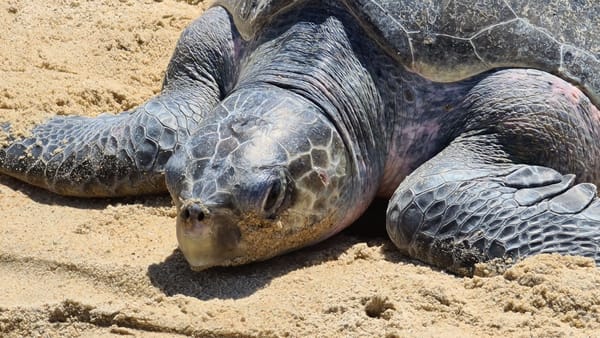
Scientific Research
California Beaches See First Olive Ridley Nesting: What This Means for Sea Turtle Conservation
Marine biologists are witnessing a historic shift in ocean ecology. On September 16, 2026, an olive ridley sea turtle laid eggs on a beach near Seal Beach in Orange County, California. This event marks the first confirmed nesting of this species on the U.S. West Coast. Historica…
Read More...
Scientific Research
PLOS Climate: Why Broken Links Threaten Global Science Access
The digital landscape of scientific communication is shifting beneath our feet. As climate research accelerates, the integrity and accessibility of this data have become paramount. Specialized journals like PLOS Climate face constant challenges regarding content availability and…
Read More...
Scientific Research
Why Climate Data Links Fail: The Open Access Fix You Need Now
Imagine clicking a link to the latest climate study only to hit a dead end. That frustrating 'Page Not Found' error is more than a technical glitch. It represents a significant barrier in the fight against misinformation and delayed action. When vital research on global warming…
Read More...
Scientific Research
What Color Is the Universe? The Surprising Beige Answer from Johns Hopkins
For centuries humanity has gazed into the night sky captivated by vibrant nebulae and dying stars. Yet a deceptively simple question remains elusive to the naked eye. What is the average color of the entire universe? The answer defies expectations of deep cosmic blues or brillia…
Read More...