
Bison DNA Study Rewrites 200,000 Years of History. Here's What It Means for Their Survival
We compile, generate and translate using Artificial Intelligence from the below given source. Macro Micro News is responsible for its editorial publication.
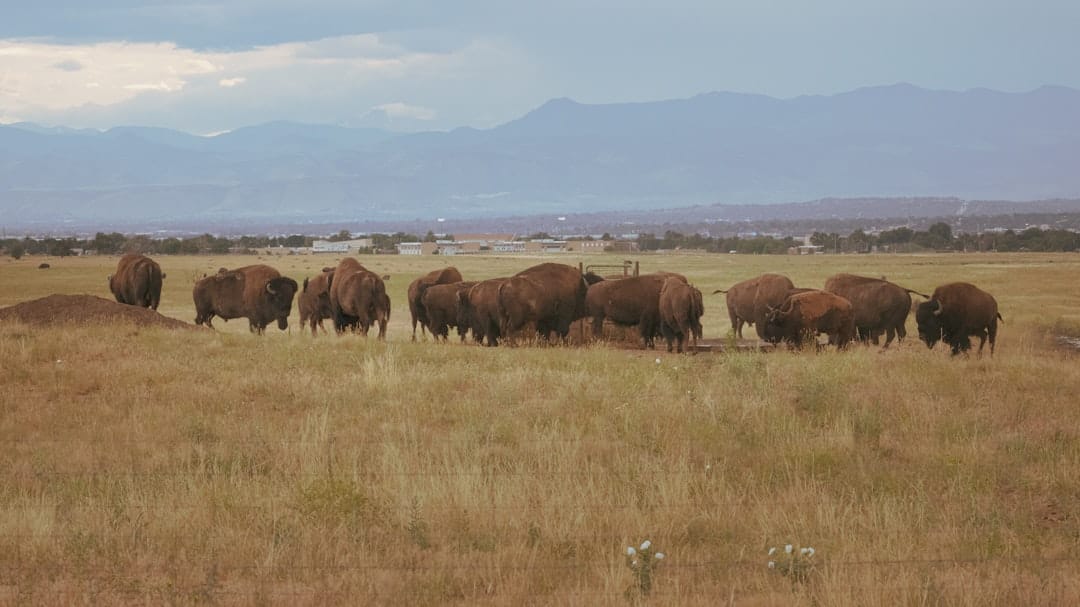
Fort Smith, Northwest Territories, Canada, MMN Correspondent: For much of American history, the bison was more than an animal. It was a moving landscape. Before European settlement, an estimated 50 million bison ranged from Mexico to Canada. Their hooves stirred the prairie, and their presence shaped the lives and stories of Indigenous peoples across the continent. Today, roughly 530,000 bison remain. The numbers alone don't tell the real story. A new study in Science, built on 160 ancient and modern bison genomes, does. Scientists have long known that bison crossed from Siberia into Alaska around 200,000 years ago. They spread quickly, filling nearly every corner of North America. What the new genome work reveals is that these early bison stayed connected. Herds from one coast to another exchanged genes so freely that they remained almost indistinguishable across the continent. That genetic flow was likely a source of strength. It allowed bison to adapt and persist through major climate shifts and changing landscapes. The species did experience narrowing moments. The first came when bison entered the continent. Another followed around 20,000 years ago during the Last Glacial Maximum. And then came the 19th century, when westward expansion, railway construction, and policies that dramatically altered Indigenous ways of life reduced bison numbers drastically. By 1890, roughly 500 bison remained in scattered groups. The surprise? Those 500 carried far more genetic diversity than expected. The close call did not instantly wipe out the species' variation. That variation is now the focus of conservation work. Modern bison herds are small and separated, often fewer than 1,000 animals. In genetics, 1,000 is a meaningful threshold. Below that, herds risk inbreeding and losing the flexibility to handle disease or environmental change. Without natural pathways for gene flow, maintaining healthy herds requires deliberate help. One of the study's biggest revelations concerns bison subspecies. For decades, researchers debated how long ago wood bison and plains bison split. The new DNA evidence places that split around 3,000 years ago. Wood bison developed a larger frame and distinctive shoulder hump for boreal forest life, and plains bison roamed open grasslands. In the 1920s, Canadian conservation managers moved nearly 7,000 plains bison into Wood Buffalo National Park, where the two groups interbred. Today, every wood bison carries some plains bison DNA. The pure wood bison lineage, under the old definitions, no longer exists. Another twist involves cattle. In the 1870s, ranchers in Texas experimented with bison and cattle hybrids. Some of these hybrids found their way into wild herds. A 2022 paper suggested that no bison alive was free of cattle DNA, a claim that spurred widespread discussion. The new genetic analysis, based on 45 modern bison genomes, offers a more reassuring view. Roughly a third carry cattle genes, which means a majority do not. These findings are already shaping practical action. The Bison Integrated Genomics Project, or BIG, brings together scientists, government agencies, and Indigenous communities around a common goal: building a biobank of bison sperm and eggs. This frozen insurance policy preserves genetic material from diverse herds and allows future reintroduction into populations that need it. In vitro fertilization in bison has been possible since 2016, with success rates around 10%, compared with 30% in cattle. Indigenous communities are central to this work. For many, bison are relatives, not resources. The Lakota writer John Fire Lame Deer captured that bond in 1972: "The buffalo was part of us, his flesh and blood being absorbed by us until it became our own flesh and blood." That connection matters today. When researchers asked to collect samples from the Ronald Lake herd in Alberta, which numbers fewer than 400 animals, the Athabasca Chipewyan First Nation took time to consider. Lori Cyprien, a land and resource manager, eventually embraced the idea. She said, "If there was a really bad season, drought, wildfires, disease, our whole herd could get wiped out. If we have their genes in a biobank, at least part of them would still be here." The genetic story of the bison reaches beyond history. It is a guide. Fayelynn Scheideman, a doctoral student studying bison genetics, puts it simply: "I would rather have bison that are robust and genetically diverse and resilient than focus on purity." The emphasis now is on resilience. Bison need enough diversity to meet the future, whether that means changing climates, emerging diseases, or shifting habitats. The work unfolding now brings together scientific tools and Indigenous knowledge, and it treats bison as partners in their own recovery. For anyone who has seen a bison herd move across open land, the stakes are clear. This species has survived the Ice Age, the end of free-ranging herds, and the twists of human intervention. The next chapter depends on the care, science, and relationships built today. The bison's past is written in their DNA. Their future is being written by us.
Related in Scientific Research

Scientific Research
PLOS Climate: How Open Access is Reshaping Global Warming Research
The landscape of scientific communication is shifting rapidly. Integrity and accessibility are no longer just nice-to-haves but essential pillars of modern research. PLOS Climate stands at the center of this transformation. This journal from the Public Library of Science in Cali…
Read More...
Scientific Research
PLOS Climate: Navigating Broken Links to Access Critical Global Warming Research
The digital landscape of scientific publishing is shifting rapidly. For researchers and enthusiasts alike, the ability to access peer-reviewed work without barriers is essential. PLOS, a nonprofit based in California, has long championed open access. Their journal PLOS Climate f…
Read More...
Scientific Research
How PLOS Climate Is Reshaping Global Science: The Open Access Advantage
In the fast-moving world of scientific communication, open access journals are doing more than just sharing papers. They are breaking down walls that have long kept knowledge out of reach. PLOS Climate stands at the center of this shift. As a key part of the Public Library of Sc…
Read More...
Scientific Research
PLOS Climate: How Open Science is Reshaping Global Data Access
The digital landscape of scientific publishing is undergoing a profound transformation. This shift is driven by the urgent need for transparency and rapid dissemination of critical research. PLOS Climate stands at the forefront of this movement. It is a specialized journal dedic…
Read More...
Scientific Research
PLOS Climate 404 Errors: How Link Rot Threatens Scientific Trust and What You Can Do
The digital landscape of scientific communication is shifting rapidly. For researchers, policymakers, and educators, the integrity of open-access journals like PLOS Climate is not just a convenience but a necessity. Yet, even the most robust platforms face technical hurdles. A r…
Read More...
Scientific Research
PLOS Climate: How Open Access is Reshaping Global Warming Solutions
The landscape of scientific publishing is shifting beneath our feet. Accessibility and transparency are no longer just nice-to-have features; they are the bedrock upon which we address the most pressing challenges of our time. The Public Library of Science (PLOS), a nonprofit ba…
Read More...
Scientific Research
California Beaches See First Olive Ridley Nesting: What This Means for Sea Turtle Conservation
Marine biologists are witnessing a historic shift in ocean ecology. On September 16, 2026, an olive ridley sea turtle laid eggs on a beach near Seal Beach in Orange County, California. This event marks the first confirmed nesting of this species on the U.S. West Coast. Historica…
Read More...
Scientific Research
PLOS Climate: Why Broken Links Threaten Global Science Access
The digital landscape of scientific communication is shifting beneath our feet. As climate research accelerates, the integrity and accessibility of this data have become paramount. Specialized journals like PLOS Climate face constant challenges regarding content availability and…
Read More...
Scientific Research
Why Climate Data Links Fail: The Open Access Fix You Need Now
Imagine clicking a link to the latest climate study only to hit a dead end. That frustrating 'Page Not Found' error is more than a technical glitch. It represents a significant barrier in the fight against misinformation and delayed action. When vital research on global warming…
Read More...
Scientific Research
What Color Is the Universe? The Surprising Beige Answer from Johns Hopkins
For centuries humanity has gazed into the night sky captivated by vibrant nebulae and dying stars. Yet a deceptively simple question remains elusive to the naked eye. What is the average color of the entire universe? The answer defies expectations of deep cosmic blues or brillia…
Read More...