
Callanish Stones: How Earth's Orbit Creates a Figure-Eight Sky Over Ancient Scotland
We compile, generate and translate using Artificial Intelligence from the below given source. Macro Micro News is responsible for its editorial publication.
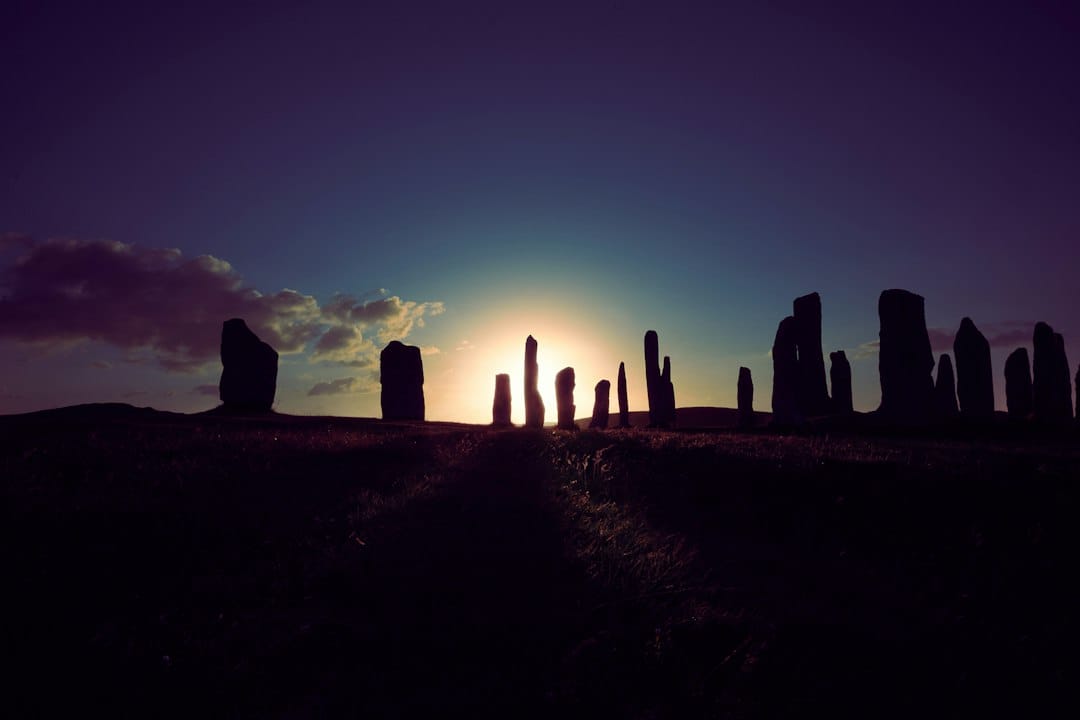
Callanish, Scotland, Source:
The night sky has long served as a canvas for humanity’s oldest questions. On September 20, 2026, the Astronomy Picture of the Day offers a unique perspective on how our planet moves through space. The featured image captures an analemma, a figure-eight pattern formed by the Sun's position in the sky, superimposed over the ancient Callanish Stones in Scotland. This striking composite image is not merely an artistic feat but a scientific visualization of Earth's complex orbital mechanics.
An analemma is created by taking a photograph of the Sun at the same clock time every day for an entire year and superimposing all those images onto a single frame. The resulting shape reveals two primary astronomical phenomena: the tilt of Earth's axis and the elliptical nature of its orbit around the Sun. The vertical extent of the figure-eight corresponds to the axial tilt, which causes the Sun to appear higher or lower in the sky depending on the season. The horizontal width results from the equation of time, a discrepancy between apparent solar time and mean solar time caused by Earth's varying orbital speed.
The foreground of this specific image features the Callanish Stones, a prehistoric stone circle located near the village of Callanish on the Isle of Lewis in the Outer Hebrides. Constructed around 2700 BC during the Neolithic period, these standing stones are among the most significant archaeological sites in Britain. While the exact purpose of the circle remains a subject of debate among archaeologists, many believe it held astronomical significance, potentially serving as an observatory for tracking solstices and equinoxes. The juxtaposition of these ancient markers with modern astrophotography creates a powerful narrative connecting human history with celestial cycles.
In the featured image, taken near the December solstice, the Sun appears near the bottom of the analemma. This positioning indicates that the photo was captured when the Sun was at its lowest point in the northern hemisphere's sky. As the Earth continues its orbit, the Sun will trace the rest of the figure-eight path. Two days after this observation, the autumnal equinox occurs, marking the moment when day and night are of equal length across the globe. This event signals a definitive change in seasons, transitioning from summer to winter in the north.
Understanding the analemma provides insight into why clocks and sundials do not always agree. It highlights the intricate relationship between Earth's rotation and revolution, reminding observers that our perception of time is deeply rooted in the physical movements of our planet. The Callanish Stones, standing silent witnesses to millennia of such cycles, offer a tangible link to the past, where early humans likely used similar natural markers to navigate their world. Today, high-resolution photography allows us to visualize these subtle shifts with precision, bridging the gap between ancient tradition and modern science.
Related in Scientific Research
Scientific Research
NASA Physics of the Cosmos: Third Early Career Workshop for Astrophysicists in September 2026
NASA’s Physics of the Cosmos Program has announced its Third Early Career Workshop, scheduled for September 22 to 24, 2026. This fully virtual event aims to support graduate students, postdoctoral researchers, and early-career scientists by providing critical insights into astro…
Read More...
Scientific Research
Houston Japan Festival 2026: NASA and JAXA Unite to Inspire Future Explorers
On September 12-13, 2026, Hermann Park in Houston buzzed with a unique energy that blended cultural celebration with the thrill of space exploration. The city’s 33rd Annual Japan Festival became more than just a showcase of heritage; it transformed into a hub for international c…
Read More...
Scientific Research
Ladakh Night Sky: Witness the Zodiacal Light Phenomenon at Hanle Reserve
On September 19, 2026, the night sky over Ladakh, India, offered a breathtaking demonstration of the zodiacal light. This phenomenon remains invisible to most urban dwellers but captivates astronomers and astrophotographers worldwide. Captured at the Hanle Dark Sky Reserve, this…
Read More...
Scientific Research
M33: The Triangulum Galaxy's Star-Forming Secrets and Cosmic Role
Deep within the northern constellation of Triangulum lies one of the most magnificent face-on spiral galaxies in our local cosmic neighborhood. Messier 33, widely known as the Triangulum Galaxy, stands as a testament to the grandeur of spiral structures in the universe. With a d…
Read More...
Scientific Research
Carina Nebula: Inside the Stellar Nursery Shaping Giant Stars
Deep within the southern sky, roughly 7,500 light-years from Earth, lies one of the most active star-forming regions in our galaxy. The Carina Nebula stands out as a vast cloud of gas and dust that acts like a cosmic treasure chest. It hides a dense cluster of young stars that a…
Read More...
Scientific Research
Webb Telescope Reveals M64's Counter-Rotating Gas: A Galaxy Merger Story
The James Webb Space Telescope has offered astronomers a striking new view of Messier 64, often called the Black Eye Galaxy. This spiral galaxy sits about 17 million light-years away in the constellation Coma Berenices. It is well known for its dark dust band that hides part of…
Read More...
Scientific Research
Watch Venus Disappear: The Rare Daytime Moon Occultation of September 15, 2026
On September 15, 2026, skywatchers around the world witnessed a rare and captivating celestial event. The Moon passed directly in front of the bright planet Venus during daylight hours. This phenomenon is often called a daytime eclipse. It temporarily hid Venus from view against…
Read More...
Scientific Research
NASA AI/ML STIG: LLM Agent Foundations for Space Science in September 2026
The convergence of astrophysics and artificial intelligence is poised to take center stage on September 14, 2026. NASA’s Cosmic Origins program will host a pivotal lecture that highlights the integration of advanced computational tools into space science. This event focuses spec…
Read More...
Scientific Research
Comet NEOWISE Over the Adriatic: A Stunning Dawn Display Captured in 2026
On September 13, 2026, the night sky provided a vivid reminder of our solar system's dynamic nature. A stunning composite image of Comet NEOWISE rising over the Adriatic Sea was featured as the Astronomy Picture of the Day by NASA Science. This visual record highlights one of th…
Read More...
Scientific Research
Apollo 11: How One Foil Sheet Captured the Sun's Breath for Science
Global, Source On September 12, 2026, NASA’s Astronomy Picture of the Day brought attention to a pivotal moment from the Apollo 11 mission. The featured image titled "Apollo 11: Catching Some Sun" shows astronaut Buzz Aldrin deploying a specialized device on the lunar surface. T…
Read More...