
Want to Wear History? IAMISIGO's Copenhagen Spring 2027 Collection Turns Memory Boards and Royal Headdresses Into Fashion
We compile, generate and translate using Artificial Intelligence from the below given source. Macro Micro News is responsible for its editorial publication.
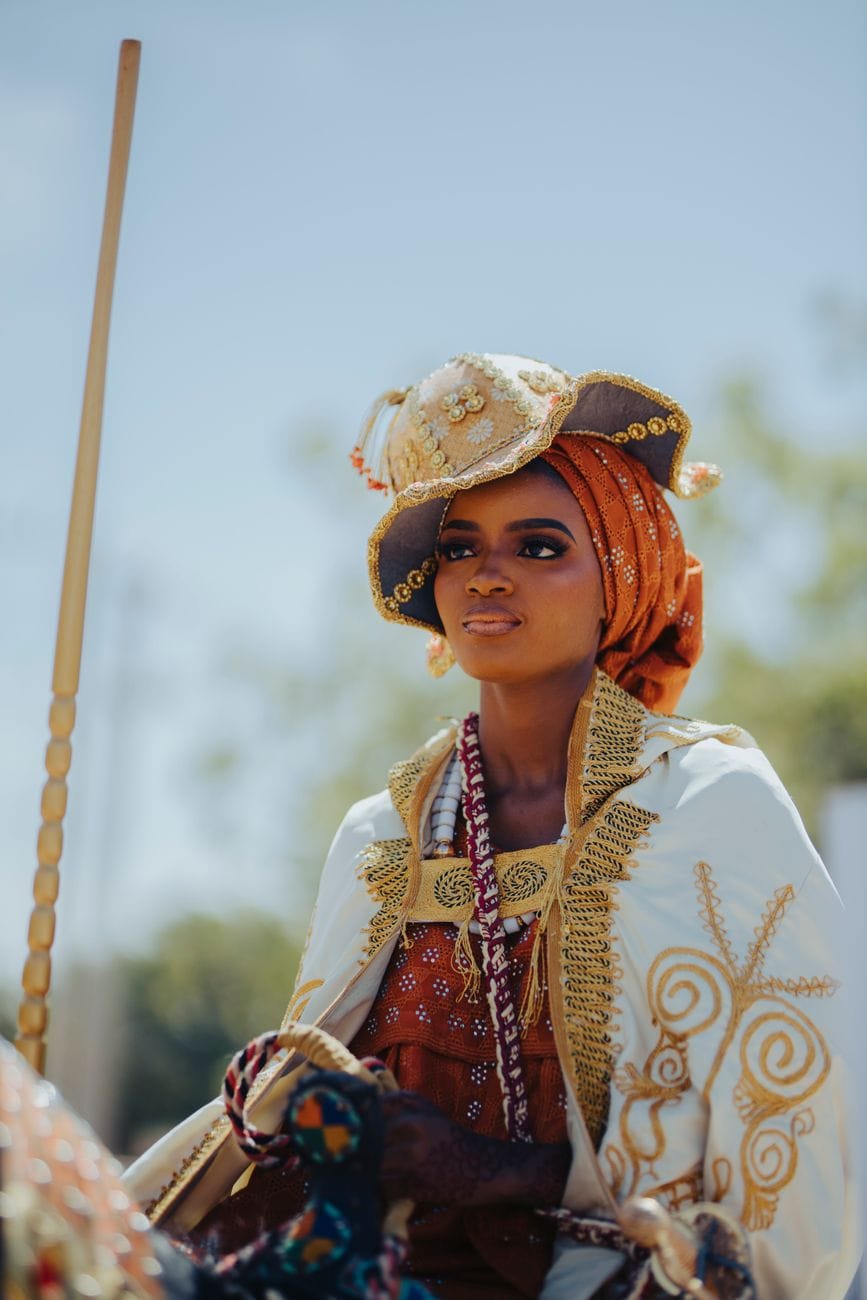
Copenhagen, Denmark, MMN Correspondent: What if a single outfit could hold centuries of knowledge? Bubu Ogisi answered that question with IAMISIGO's Spring 2027 collection at Copenhagen Fashion Week. Inside a hazy industrial hall in the Danish capital on August 8, 2026, she presented a show that turned fabric into a living archive.
The inspiration came from two powerful African traditions. The first was the lukasa memory board used by the Luba people of Central Africa during the 19th century. These carved wooden objects, decorated with beads and shells, worked as maps and historical records. They stored information in a tactile, visual language. Ogisi looked at those patterns and translated them into garments that behave like wearable archives. The second was the headdress worn by the nsɛneɛfoɔ, royal heralds of the Asante kingdom in present-day Ghana. Made from colobus monkey hide and finished with beaten gold repoussé plaques and silver chains, these headdresses carried deep meaning. They identified the wearer as someone entrusted with knowledge and authority.
For Ogisi, clothing has always been a container for stories. She put it simply: 'The first is an object that holds knowledge. The second is a human who carries it.' That duality ran through the entire collection. Inanimate memory objects met living messengers on the runway. The result felt ancient and contemporary at once, ceremonial and surprisingly wearable.
Tall hats and exaggerated shapes took center stage. These nods to African royalty reflected the belief that monarchs stayed close to the spiritual realm. Beadwork and metallic accents covered many of the headpieces, giving them an almost sacred presence. The oversized silhouettes added architectural drama. They carried the grandeur of royal regalia and expanded conventional ideas about fit and form in modern fashion.
Color grounded the collection in environmental memory. Embroidered trousers in shades of green mountain ranges, sandy dunes, and the bluest water suggested how landscapes hold memories over time. The earthy palette stayed vibrant, connecting memory to place. Every stitch seemed to trace a river, a peak, or a desert. That level of detail is a signature of IAMISIGO, a brand built on artisanal craftsmanship and sustainable practice.
IAMISIGO has always been a space for exploring African identity through a contemporary lens. The brand's name comes from the Igbo language and speaks to a mission of celebrating African cultures in their full richness. Bubu Ogisi, of Nigerian and Kenyan descent, draws on spirituality, heritage, and diaspora in her work. She often uses hand-weaving, dyeing, and embroidery, collaborating with artisans across the continent to keep age-old crafts alive and evolving.
Copenhagen Fashion Week gave this vision a fitting home. The city is known for sustainability and innovation, and IAMISIGO's ethical production and natural materials align with that energy. Presenting in Copenhagen put Ogisi in front of a global audience and placed her inside a larger conversation about fashion's future, one where cultural authenticity matters more than fleeting trends.
The timing feels important. As digital spaces and global influences multiply, traditional knowledge can easily become distant. IAMISIGO brings it back into reach. The lukasa boards were active tools for remembering. By reimagining them as fashion, Ogisi invites us to ask how we might carry our own histories forward in meaningful, beautiful ways.
The Asante heralds add another layer. Their role shows how individuals act as guardians of collective memory. Oral tradition and ceremonial practice keep culture alive across generations. The nsɛneɛfoɔ embodied the kingdom's history and values through their presence and dress. Ogisi's contemporary take on those figures reveals how such roles remain relevant, even as their outward forms change.
Craft was the quiet star of the show. Each piece demanded hours of labor from artisans working with techniques passed down through generations. The embroidery alone was a display of extraordinary patience and skill. By putting these processes at the center, IAMISIGO offers a slower, more intentional way of making clothes. That approach speaks to a growing audience that wants transparency, sustainability, and stories in what they wear.
Collections like this one point toward a future where fashion can be both visually exciting and culturally significant. IAMISIGO's Spring 2027 offering reads as a narrative. It creates a dialogue between past and present, object and human, memory and material. It invites everyone who sees it to reflect on their own connection to history and to notice the stories they carry with them.
With this collection, Bubu Ogisi once again showed how complex cultural ideas can become wearable forms. Drawing from Luba and Asante traditions, she made pieces that honor the past and speak directly to the present. IAMISIGO continues to stand out as one of the most innovative and culturally aware labels in fashion today, a clear example of what happens when creativity is rooted in heritage and purpose.
Related in Fashion

Fashion
How TERREMOTO’s Omni-Positive Gardens Are Rewriting the Rules of Ecological Design
Landscape architecture is undergoing a profound transformation. The firm TERREMOTO has been named a winner of the 2025 National Design Awards by Cooper Hewitt Smithsonian Design Museum. This recognition highlights their pioneering manifesto on radical gardening. They are creatin…
Read More...
Fashion
Frederic Church in Jamaica: Grief, Colonial History, and Rare Sketches at Cooper Hewitt
This fall, the Cooper Hewitt, Smithsonian Design Museum invites you to explore a deeply personal chapter in art history with "Frederic Church in Jamaica." This landmark exhibition showcases rarely seen sketches from the acclaimed American painter’s 1865 journey to the Caribbean.…
Read More...
Fashion
How Christopher Payne Captures the MTA's Hidden Rhythm: A New York Photography Insight
Have you ever wondered what happens when the last train leaves the station? Beneath the roar of daily commuters and the screech of subway brakes lies a complex ecosystem that rarely sees the light of day. Photographer Christopher Payne has dedicated his career to illuminating th…
Read More...
Fashion
The Shards Episode 4: 1980s LA Horror, Nostalgia, and a Glee Cameo You Need to See
If you have been waiting for a reason to press play on The Shards, Episode 4 is it. The FX series, adapted from Bret Easton Ellis's novel, locks into a groove that feels equal parts dangerous and dreamy. It captures the specific pull of late 1980s Los Angeles, where glamour and…
Read More...
Fashion
What Your Hair Routine Is Missing: 3 Korean Scalp Spa Steps for Healthier Hair
What if the hair you see every day is only the end result of something far more important happening underneath? At a traditional Korean head spa in Seoul, the spotlight shifts away from the lengths and ends and lands directly on the scalp. That tiny shift in attention can change…
Read More...
Fashion
Oprah Winfrey and Stedman Graham: 40 Years Together, Never Married, and What That Teaches You About Love
When Oprah Winfrey and Stedman Graham stepped out together recently for the 40th anniversary celebration of The Oprah Winfrey Show, it marked their first public appearance together in seven years. The moment felt like a quiet reminder that some love stories simply keep going, no…
Read More...
Fashion
See How Stel Copenhagen Spring 2027 Reinvents Feminine Tailoring with Skate-Ready Denim and Travel-Friendly Shirting
What happens when a designer known for bold London streetwear trades a bustling city for the quiet landscapes of Jutland? The answer came on August 10, 2026, when Astrid Andersen presented Stel's Spring 2027 collection during Copenhagen Fashion Week. It is a deeply personal, qui…
Read More...
Fashion
Discover How IAMISIGO's Copenhagen Spring 2027 Collection Transforms African Memory and Royalty into Fashion
There are moments during fashion week when a runway show becomes something deeper. IAMISIGO's Spring 2027 presentation in Copenhagen was one of those moments. Held inside a raw industrial space with soft hazy light, it felt like a conversation with history. What if a garment cou…
Read More...
Fashion
Caro Editions Spring 2027 at Copenhagen Fashion Week: Princess Diana’s Legacy Meets Scandi Cool, Your First Look
What if the world of Scandinavian fashion merged with the most expressive chapter of Princess Diana’s wardrobe? The answer came down the runway at Caro Editions’ Spring 2027 showcase during Copenhagen Fashion Week. Designer Caroline Bille Brahe, who founded the label just four y…
Read More...
Fashion
Caro Editions Copenhagen Spring 2027: The 80% Sustainable Minimalist Collection You Need to See
What does Scandinavian minimalism look like when it stops performing and starts living? Caro Editions answered that question at Copenhagen Fashion Week with a collection that felt like a long, calm exhale. The Danish label has always stood for understated elegance. Spring 2027 t…
Read More...