
Saturn's Cosmic Clarity: How One Night Revealed the Ringed Planet's Secrets
We compile, generate and translate using Artificial Intelligence from the below given source. Macro Micro News is responsible for its editorial publication.
London, United Kingdom, Source:
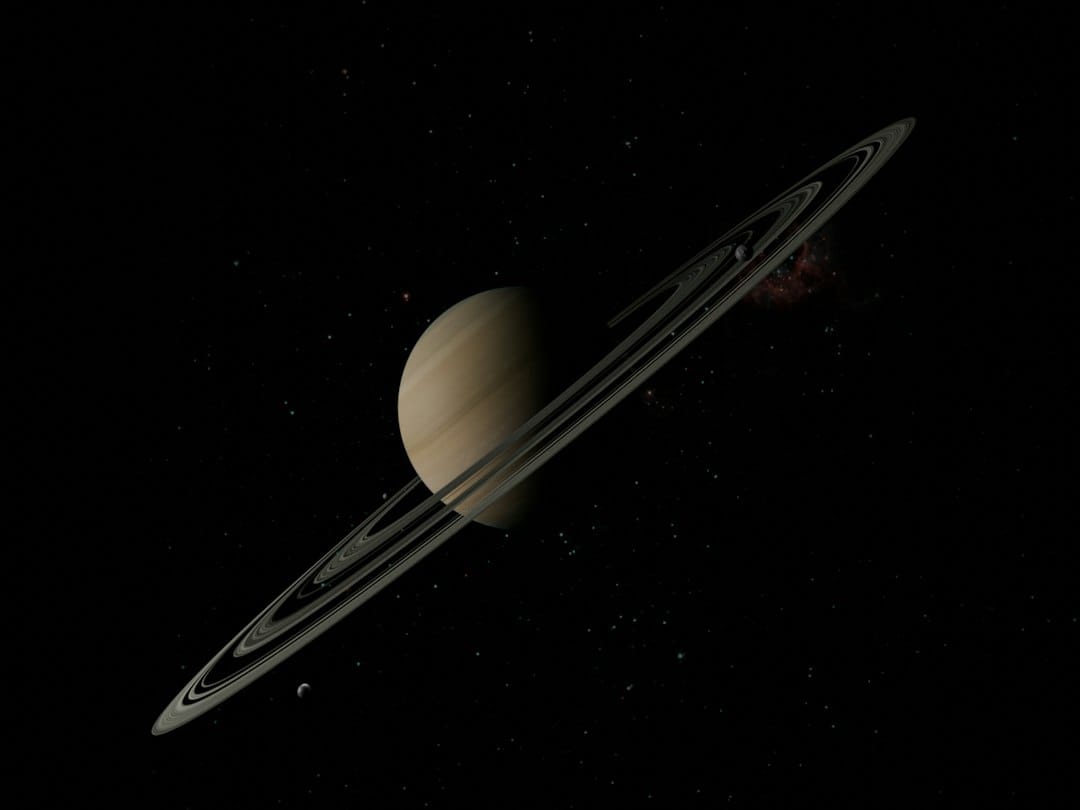
On October 8, 2026, the Astronomy Picture of the Day featured a breathtaking composite image titled "The Saturn System Smörgåsbord." This visual feast offers an unprecedented view of the ringed planet and its diverse moons. Astrophotographer Tom Williams captured this exquisite scene during one night of exceptional atmospheric conditions above the United Kingdom. The result is a testament to human ingenuity in observational astronomy.
Saturn’s appearance in the night sky often suffers from distortion due to Earth’s atmosphere. This phenomenon, known as astronomical seeing, occurs when pockets of air at varying temperatures and densities move chaotically. These movements refract light from distant stars and planets, typically blurring fine details. High-resolution imaging becomes a significant challenge under such turbulent conditions.
However, that specific night offered unusually high atmospheric stability. This rare window allowed for deep-sky photography with remarkable clarity. To further mitigate any residual distortion, Williams employed a technique called lucky imaging. This method involves capturing thousands of short-exposure frames using a high-speed camera.
Astronomers then select only the sharpest images. These are the frames least affected by momentary atmospheric glitches. By stacking these selected images together, they produce results that rival space-based telescopes in clarity. The process transforms chaotic data into a coherent and stunning visual record.
The timing of this observation was particularly opportune. Just four days prior, on October 4, 2026, Saturn experienced an equinox. During this event, Earth passes directly between the Sun and Saturn. This alignment causes the planet’s rings to appear edge-on or nearly so from our perspective.
While this geometry minimizes the visual width of the rings, it offers unique scientific insights. Researchers can study the structure and vertical thickness of the rings more effectively. Furthermore, Saturn’s proximity to Earth during this period combined with full illumination from the Sun creates ideal conditions. Observers can examine surface features and moon systems with greater precision.
The title "Smörgåsbord" reflects the variety of celestial bodies included in the frame. The image likely showcases major moons such as Titan, Rhea, and Enceladus. It also highlights the intricate banding of Saturn’s cloud tops. This composition invites viewers to appreciate the complexity of the Saturnian system.
This image highlights the enduring value of ground-based astronomy. When supported by advanced post-processing techniques, terrestrial observations remain powerful tools. Amateur and professional photographers contribute significantly to public engagement with science. They reveal the beauty of our solar system to a global audience.
As technology advances, the ability to correct for atmospheric interference improves. Observers on Earth continue to explore the cosmos with increasing precision. This progress bridges the gap between terrestrial limitations and cosmic wonders. The story of this image reminds us that clear skies and clever techniques can unveil the universe's grandeur.
Related in Space Tech
Space Tech
Stickney Crater: How a Massive Impact Nearly Destroyed Mars' Moon Phobos
Phobos, the innermost moon of Mars, carries a scar that tells a story of cosmic violence. Stickney Crater dominates its surface, a colossal basin named after Angeline Stickney Hall, wife of astronomer Asaph Hall. Hall discovered both Phobos and Deimos in 1877, linking human hist…
Read More...
Space Tech
Artemis II Crew Captures Lunar Impact Flashes: What the Moon Revealed in April 2026
NASA has shared a remarkable dataset from the Artemis II mission that offers fresh perspectives on our lunar neighbor. The journey occurred between April 1 and April 10, 2026, marking the first crewed trip to the Moon's vicinity since the Apollo days. Astronauts Reid Wiseman, Vi…
Read More...
Space Tech
Pa 30: The 845-Year-Old Supernova Mystery That Defies Standard Models
The night sky holds countless stories written in light and dust. Among these celestial narratives, supernova remnants stand as testaments to the violent yet creative end of stellar lives. These expanding shells do more than mark a star's death. They scatter heavy elements across…
Read More...
Space Tech
Earth's Full Aurora Ring Revealed: SMILE Mission Captures Complete View
Scientists have achieved a remarkable first by capturing the entire auroral oval in one continuous shot. The Solar Wind Magnetosphere Ionosphere Link Explorer mission shared this image on October 6, 2026. This perspective offers a fresh look at how our planet interacts with the…
Read More...
Space Tech
Sombrero Galaxy M104: New Deep-Exposure Image Reveals Tidal Streams and Violent History
The Sombrero Galaxy, known scientifically as Messier 104 or M104, has always drawn the eye with its striking resemblance to a wide-brimmed Mexican hat. This massive spiral galaxy features a bright central bulge encircled by a distinctive dark band of interstellar dust. While ast…
Read More...
Space Tech
New Jersey Sky: Witnessing Supernumerary Rainbows and the Wave Nature of Light
On October 4, 2026, the skies above New Jersey presented a rare spectacle that captivated both amateur photographers and meteorology enthusiasts. Following the passage of storm remnants over the Jersey Shore, a standard rainbow appeared in one direction. However, the phenomenon…
Read More...
Space Tech
Mars Rover's New Selfie Reveals Vera Rubin Ridge Secrets
NASA’s Curiosity rover has once again provided humanity with a breathtaking glimpse into the red planet. The vehicle captured a stunning panoramic selfie at the south rim of Vera Rubin Ridge. This image served as the Astronomy Picture of the Day for October 3, 2026. It marks a s…
Read More...
Space Tech
313 Nebulas Captured: The Complete Sharpless Catalog Revealed in Eastern China
On October 2, 2026, NASA’s Astronomy Picture of the Day highlighted a monumental achievement in astrophotography. The complete Sharpless Catalog has been unveiled, showcasing 313 distinct nebulae. This comprehensive collection offers an unprecedented opportunity to explore the d…
Read More...
Space Tech
Harvest Moon Meets Etna: Why This October 2026 Sky Was Unforgettable
On October 1, 2026, the night sky delivered a breathtaking convergence of astronomical precision and geological fury. A stunning composite image has captivated astronomy enthusiasts worldwide by capturing this rare moment. The photograph features the Harvest Moon rising over the…
Read More...
Space Tech
Arp 78: Aries Galaxy's Massive Spiral Arm Reveals Cosmic Collision History
Deep within the constellation of Aries, roughly 100 million light-years from Earth, astronomers have identified a celestial spectacle that challenges our understanding of galactic evolution. Arp 78 stands out as one of the most visually compelling examples of interacting galaxie…
Read More...