
See the August 2026 Solar Eclipse in 3 Dimensions: NASA's Ground, Air, and Space Views Reveal the Corona
We compile, generate and translate using Artificial Intelligence from the below given source. Macro Micro News is responsible for its editorial publication.
Washington, D.C., Source :
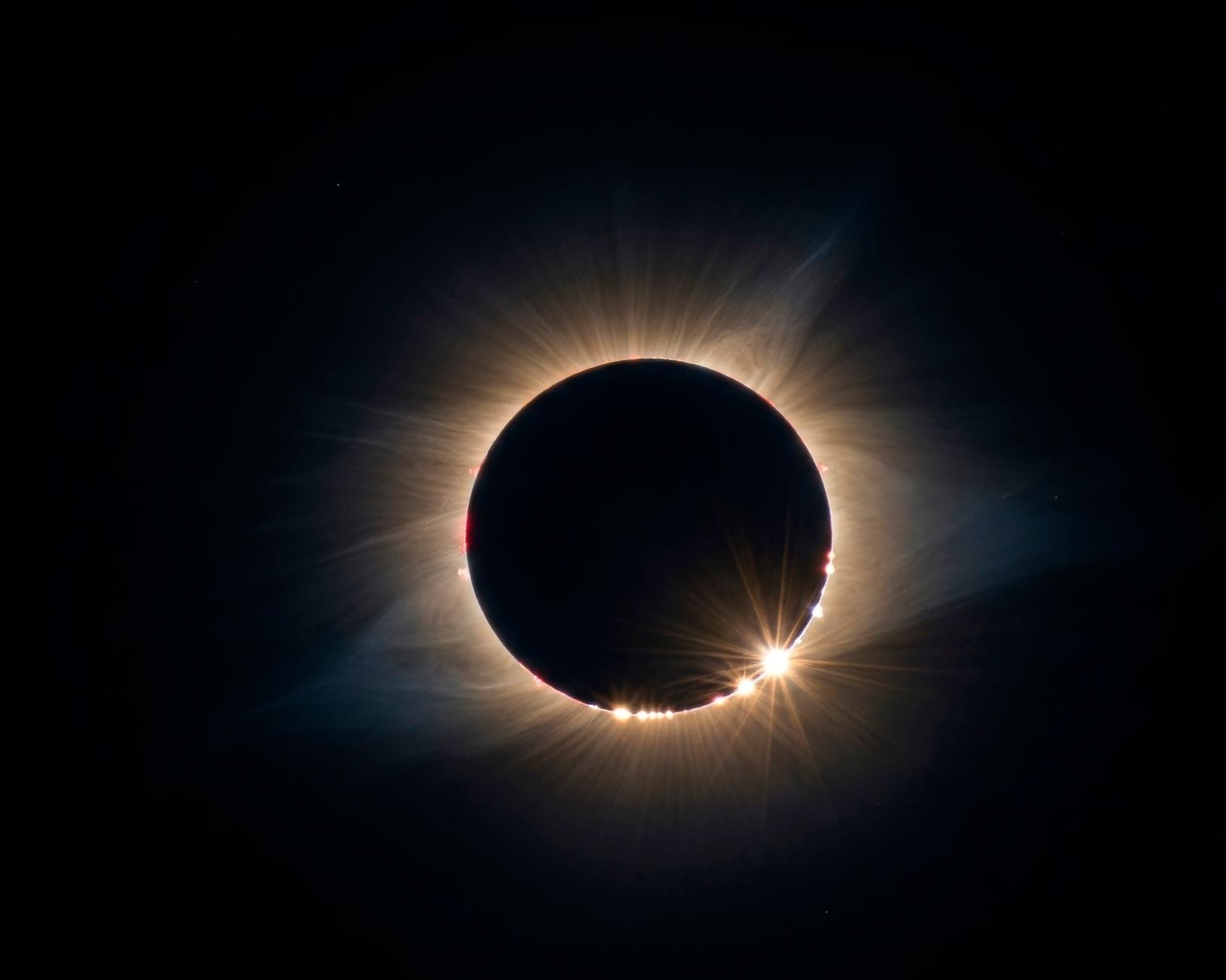
On Aug. 12, 2026, the Moon moved directly between the Sun and Earth. For a few unforgettable minutes, a total solar eclipse transformed daylight into twilight across Greenland, Iceland, and Spain. What does a moment like this look like from every possible angle? NASA and its partners set out to answer that question. Photographers, pilots, astronauts, and student teams all contributed to a rare multidimensional view of the eclipse.
On the ground in Spain, NASA photographer Bill Ingalls chose the small town of San Millán de los Caballeros as his viewpoint. He tracked the Sun through total eclipse and into the final partial phases before sunset. His composite images show the eclipsed Sun sinking over the horizon, with one especially beautiful sequence above a field of sunflowers. One frame reveals the corona in fine detail. Another catches a pink solar prominence, a plume of electrically charged gas held in place by magnetic forces along the edge of the darkened Sun. The results are both scientific and deeply artistic.
Farther north, in Maine, the sky offered only a partial eclipse. That gave the scene an extra layer of drama. A NASA photographer captured something rare: the International Space Station streaking across the partially eclipsed Sun. The sequence consists of 12 frames and shows the station in stark silhouette, moving at roughly five miles per second. Seven crew members were aboard at the time. They were part of Expedition 75, including NASA astronauts Jessica Meir, Anil Menon, and Jack Hathaway, ESA astronaut Sophie Adenot, and Roscosmos cosmonauts Pyotr Dubrov, Andrey Fedyaev, and Anna Kikina. Clouds partially veiled the Sun, and the transit still came through with striking clarity.
From roughly 250 miles above Earth, the eclipse looked different again. NASA astronaut Jessica Meir captured a photograph of the partial eclipse from the International Space Station while it soared 262 miles above southern Quebec, Canada. At the peak, the Moon covered about 18 percent of the Sun. Eighteen percent might sound modest. From orbit, it created a view that feels spacious and quiet, a reminder that an eclipse from space is more than a smaller version of what we see from the ground.
Between the ground and the space station, NASA pilots flew the WB-57F research jet to 50,000 feet. From there, the jet intercepted the eclipse's shadow and stretched out its time in totality. A set of onboard cameras recorded the corona and prominences in visible and infrared light. The science team, led by the Southwest Research Institute in Boulder, Colorado, will study those images closely. They hope to learn how the Sun's outer atmosphere creates and shapes the structures that appear so brilliantly during totality.
Student teams supported by the NASA-funded Nationwide Eclipse Ballooning Project launched scientific balloons from Iceland and Spain. Where clouds blocked the view on the ground, the balloon instruments kept collecting data about how the sudden loss of sunlight and heat affected the lower atmosphere. One camera from a balloon launched in Spain captured the Moon's shadow sweeping across the atmosphere. That vantage point turned the eclipse into a wide-angle spectacle and showed how the event reached far beyond the narrow path of totality.
Before the eclipse, scientists built a prediction of what the corona would look like. They used observations from NASA spacecraft, ground-based telescopes, and supercomputers. Later, they compared that model to a composite image captured near León, Spain, by the NASA-supported DEB Initiative team. The matchup is impressive. It shows how accurate solar modeling has become and how much more we can learn about the Sun's ever-changing outer atmosphere.
Over the coming months, researchers will analyze every image and data set from Aug. 12. These observations will enrich our understanding of the Sun and its connection to Earth. They will also guide preparations for the next major total solar eclipse on Aug. 2, 2027, visible from southern Spain and northern Africa. If one eclipse can be captured with this much depth, the next one might be even more revealing.
Related in Space Tech
Space Tech
Lunar Farside Revealed: 15,000 Images Uncover Ancient Moon Terrain
For centuries we have looked up and seen only one face of our nearest celestial neighbor. Tidal locking keeps the far side turned away from Earth, creating a permanent blind spot in human history. Modern orbital technology has now lifted that veil. A detailed mosaic captured by…
Read More...
Space Tech
Stickney Crater: How a Massive Impact Nearly Destroyed Mars' Moon Phobos
Phobos, the innermost moon of Mars, carries a scar that tells a story of cosmic violence. Stickney Crater dominates its surface, a colossal basin named after Angeline Stickney Hall, wife of astronomer Asaph Hall. Hall discovered both Phobos and Deimos in 1877, linking human hist…
Read More...
Space Tech
Saturn's Cosmic Clarity: How One Night Revealed the Ringed Planet's Secrets
On October 8, 2026, the Astronomy Picture of the Day featured a breathtaking composite image titled "The Saturn System Smörgåsbord." This visual feast offers an unprecedented view of the ringed planet and its diverse moons. Astrophotographer Tom Williams captured this exquisite…
Read More...
Space Tech
Artemis II Crew Captures Lunar Impact Flashes: What the Moon Revealed in April 2026
NASA has shared a remarkable dataset from the Artemis II mission that offers fresh perspectives on our lunar neighbor. The journey occurred between April 1 and April 10, 2026, marking the first crewed trip to the Moon's vicinity since the Apollo days. Astronauts Reid Wiseman, Vi…
Read More...
Space Tech
Pa 30: The 845-Year-Old Supernova Mystery That Defies Standard Models
The night sky holds countless stories written in light and dust. Among these celestial narratives, supernova remnants stand as testaments to the violent yet creative end of stellar lives. These expanding shells do more than mark a star's death. They scatter heavy elements across…
Read More...
Space Tech
Earth's Full Aurora Ring Revealed: SMILE Mission Captures Complete View
Scientists have achieved a remarkable first by capturing the entire auroral oval in one continuous shot. The Solar Wind Magnetosphere Ionosphere Link Explorer mission shared this image on October 6, 2026. This perspective offers a fresh look at how our planet interacts with the…
Read More...
Space Tech
Sombrero Galaxy M104: New Deep-Exposure Image Reveals Tidal Streams and Violent History
The Sombrero Galaxy, known scientifically as Messier 104 or M104, has always drawn the eye with its striking resemblance to a wide-brimmed Mexican hat. This massive spiral galaxy features a bright central bulge encircled by a distinctive dark band of interstellar dust. While ast…
Read More...
Space Tech
New Jersey Sky: Witnessing Supernumerary Rainbows and the Wave Nature of Light
On October 4, 2026, the skies above New Jersey presented a rare spectacle that captivated both amateur photographers and meteorology enthusiasts. Following the passage of storm remnants over the Jersey Shore, a standard rainbow appeared in one direction. However, the phenomenon…
Read More...
Space Tech
Mars Rover's New Selfie Reveals Vera Rubin Ridge Secrets
NASA’s Curiosity rover has once again provided humanity with a breathtaking glimpse into the red planet. The vehicle captured a stunning panoramic selfie at the south rim of Vera Rubin Ridge. This image served as the Astronomy Picture of the Day for October 3, 2026. It marks a s…
Read More...
Space Tech
313 Nebulas Captured: The Complete Sharpless Catalog Revealed in Eastern China
On October 2, 2026, NASA’s Astronomy Picture of the Day highlighted a monumental achievement in astrophotography. The complete Sharpless Catalog has been unveiled, showcasing 313 distinct nebulae. This comprehensive collection offers an unprecedented opportunity to explore the d…
Read More...