
Sombrero Galaxy M104: New Deep-Exposure Image Reveals Tidal Streams and Violent History
We compile, generate and translate using Artificial Intelligence from the below given source. Macro Micro News is responsible for its editorial publication.
United States, Source:
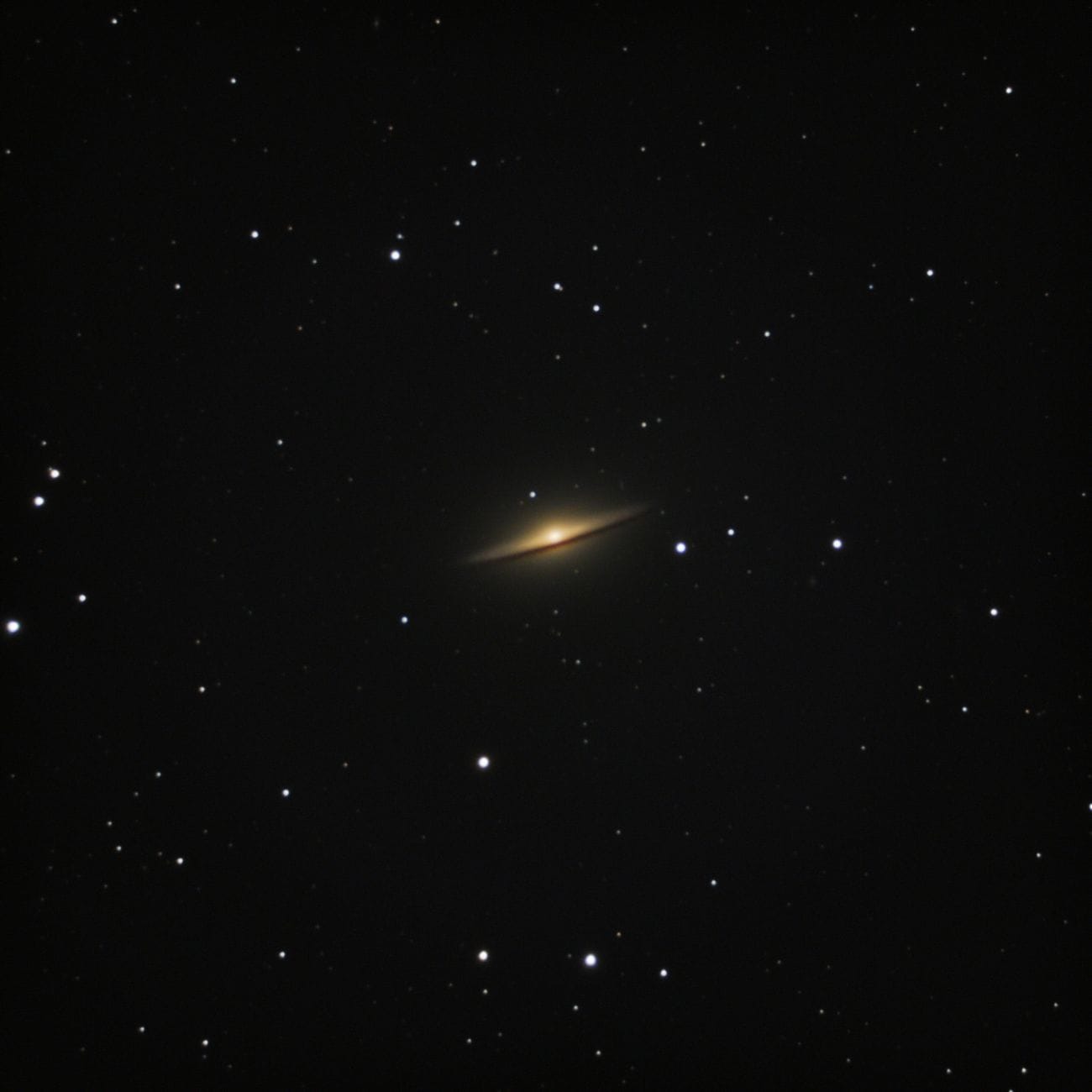
The Sombrero Galaxy, known scientifically as Messier 104 or M104, has always drawn the eye with its striking resemblance to a wide-brimmed Mexican hat. This massive spiral galaxy features a bright central bulge encircled by a distinctive dark band of interstellar dust. While astronomers have long appreciated this clear view from Earth, recent deep-exposure imaging suggests there is much more to discover within its structure.
A groundbreaking image released on October 5, 2026, by NASA’s Astronomy Picture of the Day series exposes details that standard observation techniques often miss. By using significantly longer exposure times, astronomers penetrated the stellar haze around the galaxy’s core. This extended view revealed faint, hairy tidal streams extending well beyond the central disk. These streams are not just decorative elements but consist of countless unresolved stars pulled away during gravitational interactions.
Within these stellar streams, researchers have identified distinct structures, including remnants of smaller satellite galaxies consumed by M104 over billions of years. The presence of these tidal streams offers compelling evidence that the Sombrero Galaxy experienced a dynamic past marked by frequent collisions and mergers with smaller galactic neighbors. Such events play a crucial role in shaping the morphology and star formation rates of large galaxies through gravitational disruption.
M104 sits approximately 30 million light-years away in the constellation Virgo. It spans an impressive 150,000 light-years across, making it larger than our own Milky Way. The light captured in this new image began its journey toward Earth 30 million years ago, offering a glimpse into the galaxy’s state during the late Pleistocene epoch on Earth. Data for this remarkable image was collected over seven days in mid-2026, allowing researchers to map the intricate distribution of stars and dust with unprecedented clarity.
This discovery highlights the value of deep-field observations in understanding galactic evolution. By analyzing the composition and trajectory of these tidal streams, scientists can reconstruct the merger history of M104. This process provides valuable insights into how large galaxies grow and evolve in the universe. The Sombrero Galaxy remains a key laboratory for studying galactic dynamics, proving that even well-known celestial objects hold new secrets waiting to be uncovered through advanced observational technology.
Related in Space Tech

Space Tech
Stickney Crater: How a Massive Impact Nearly Destroyed Mars' Moon Phobos
Phobos, the innermost moon of Mars, carries a scar that tells a story of cosmic violence. Stickney Crater dominates its surface, a colossal basin named after Angeline Stickney Hall, wife of astronomer Asaph Hall. Hall discovered both Phobos and Deimos in 1877, linking human hist…
Read More...
Space Tech
Saturn's Cosmic Clarity: How One Night Revealed the Ringed Planet's Secrets
On October 8, 2026, the Astronomy Picture of the Day featured a breathtaking composite image titled "The Saturn System Smörgåsbord." This visual feast offers an unprecedented view of the ringed planet and its diverse moons. Astrophotographer Tom Williams captured this exquisite…
Read More...
Space Tech
Artemis II Crew Captures Lunar Impact Flashes: What the Moon Revealed in April 2026
NASA has shared a remarkable dataset from the Artemis II mission that offers fresh perspectives on our lunar neighbor. The journey occurred between April 1 and April 10, 2026, marking the first crewed trip to the Moon's vicinity since the Apollo days. Astronauts Reid Wiseman, Vi…
Read More...
Space Tech
Pa 30: The 845-Year-Old Supernova Mystery That Defies Standard Models
The night sky holds countless stories written in light and dust. Among these celestial narratives, supernova remnants stand as testaments to the violent yet creative end of stellar lives. These expanding shells do more than mark a star's death. They scatter heavy elements across…
Read More...
Space Tech
Earth's Full Aurora Ring Revealed: SMILE Mission Captures Complete View
Scientists have achieved a remarkable first by capturing the entire auroral oval in one continuous shot. The Solar Wind Magnetosphere Ionosphere Link Explorer mission shared this image on October 6, 2026. This perspective offers a fresh look at how our planet interacts with the…
Read More...
Space Tech
New Jersey Sky: Witnessing Supernumerary Rainbows and the Wave Nature of Light
On October 4, 2026, the skies above New Jersey presented a rare spectacle that captivated both amateur photographers and meteorology enthusiasts. Following the passage of storm remnants over the Jersey Shore, a standard rainbow appeared in one direction. However, the phenomenon…
Read More...
Space Tech
Mars Rover's New Selfie Reveals Vera Rubin Ridge Secrets
NASA’s Curiosity rover has once again provided humanity with a breathtaking glimpse into the red planet. The vehicle captured a stunning panoramic selfie at the south rim of Vera Rubin Ridge. This image served as the Astronomy Picture of the Day for October 3, 2026. It marks a s…
Read More...
Space Tech
313 Nebulas Captured: The Complete Sharpless Catalog Revealed in Eastern China
On October 2, 2026, NASA’s Astronomy Picture of the Day highlighted a monumental achievement in astrophotography. The complete Sharpless Catalog has been unveiled, showcasing 313 distinct nebulae. This comprehensive collection offers an unprecedented opportunity to explore the d…
Read More...
Space Tech
Harvest Moon Meets Etna: Why This October 2026 Sky Was Unforgettable
On October 1, 2026, the night sky delivered a breathtaking convergence of astronomical precision and geological fury. A stunning composite image has captivated astronomy enthusiasts worldwide by capturing this rare moment. The photograph features the Harvest Moon rising over the…
Read More...
Space Tech
Arp 78: Aries Galaxy's Massive Spiral Arm Reveals Cosmic Collision History
Deep within the constellation of Aries, roughly 100 million light-years from Earth, astronomers have identified a celestial spectacle that challenges our understanding of galactic evolution. Arp 78 stands out as one of the most visually compelling examples of interacting galaxie…
Read More...