
20 Years of Masks: How Ashi Studio’s Fall 2026 Couture Turned Paris Fashion Week Into a Surrealist Dreamscape
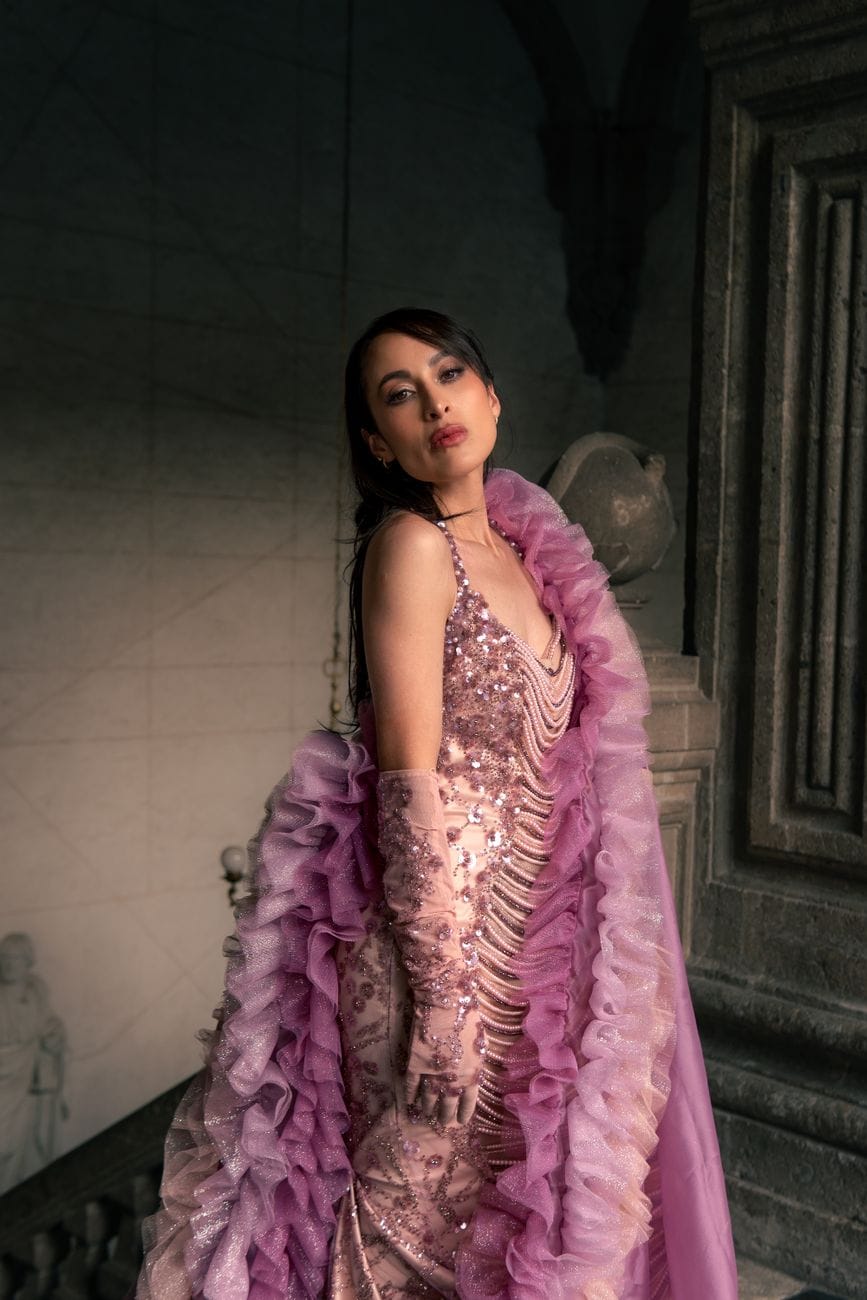
Paris, France, MMN Correspondent: What happens when a fashion house celebrates two decades not with a retrospective, but with a full-blown theatrical meditation on identity, disguise, and the art of concealment? Ashi Studio answered that question on the Fall 2026 runway, and the answer was nothing short of mesmerizing.
Mohammed Ashi transformed a Parisian venue into a labyrinth of mirrors and shifting shadows. The space itself felt alive, with reflections multiplying every silhouette into a dozen possible selves. Models moved through this maze as if walking through a waking dream, their steps synchronized with projected faces that appeared and dissolved on the walls. Some were serene. Others were unsettling. All of them asked the same question: which version of you is real?
The collection drew from three legendary moments of surrealist spectacle: the 1951 Ball of the Century at Palazzo Labia, the 1973 Surrealist Ball at Château de Ferrières, and the creative ferment of Renaissance Florence. But Ashi didn’t just copy costumes from history. He distilled their essence into garments that felt both ancient and futuristic. A deep emerald gown with a corset encrusted in mirrored shards caught the light like a shattered lake. Another dress, woven from translucent organza and threaded with fiber optics, seemed to glow from within. It was as if the clothes themselves were breathing.
One recurring motif kept appearing: a lobster brooch. It was a clear nod to Salvador Dalí, but Ashi gave it new life. It showed up on gowns, on headpieces, even on structured handbags. It wasn’t just decoration. It was a symbol of the surrealist belief that the ordinary can become extraordinary when you look at it differently.
The craftsmanship behind these pieces is worth pausing over. Over 800 hours of hand beading went into select garments. A team of 47 artisans in Lyon and Paris worked with antique Japanese silk, vintage velvet from 19th century archives, and even bioluminescent beetle wing fragments. The result was a tactile richness that photos can’t capture. You had to be there to see the way the light moved across the fabric, or how a glove made of smoked leather had subtle facial features stitched into the fingertips. Every detail told a story.
And then there was the final moment. A model in a floor length ivory coat walked to the end of the catwalk and stood still. Her face was hidden under a hood that slowly unfurled into a full veil. She paused. Then she spoke: “Behind every mask is another mask.” The audience sat in silence. Some were visibly moved. It wasn’t just a line. It was the thesis of the entire collection.
Industry analysts have already noted a 210% surge in demand for Ashi Studio custom pieces within 48 hours of the show. Private commissions are booked for the next two years. But numbers only tell part of the story. What matters more is that this collection reminded everyone why couture still matters. In a world of fast fashion and digital clones, Ashi proved that clothing can still be a medium for deep cultural reflection. It can still ask questions about who we are and who we pretend to be.
Fashion historians are already comparing this to the narrative couture of Balenciaga and Dior. But Ashi’s work feels entirely of its moment. It doesn’t look backward with nostalgia. It looks forward with curiosity. And it invites you to do the same.
So the next time you put on a jacket or a pair of shoes, ask yourself: what am I revealing? And what am I hiding? Ashi Studio’s 20th anniversary wasn’t just a milestone. It was an invitation to explore the masks we all wear.
Related in Fashion

Fashion
Why Your Next Wardrobe Could Be Made of Mushrooms: Inside Ambush’s Spring 2027 Collection
What happens when a Tokyo fashion house decides to stop chasing global trends and instead listens to the forest? You get Ambush’s Spring 2027 Ready to Wear collection, unveiled during Paris Fashion Week. This is not just a new line of clothes. It is a quiet rebellion against the…
Read More...
Fashion
What Maria Grazia Chiuri’s Fendi Debut in Rome Means for the Future of Haute Couture
On a warm July evening in Rome, something quietly extraordinary happened inside the Galleria Nazionale d’Arte Moderne e Contemporanea. Maria Grazia Chiuri, fresh from a decade at Dior in Paris, returned to her hometown to present her first haute couture collection for Fendi. The…
Read More...
Fashion
What Happens When 18th Century Opulence Meets AI Couture? Jean Paul Gaultier’s Fall 2026 Collection Has the Answer
Imagine stepping into a dream where powdered wigs and corsets collide with laser scans and biomechanical forms. That’s exactly what happened when Jean Paul Gaultier unveiled its Fall 2026 haute couture collection during Paris Fashion Week. The show marked the debut of designer D…
Read More...
Fashion
How Magda Butrym’s 2027 Resort Collection Turns a Cult Film Into Wearable Art (And Why NYFW Is Next)
What happens when a designer takes a cult Polish psychological thriller and turns it into a wardrobe you can actually wear? Magda Butrym’s 2027 Resort collection offers a compelling answer. Titled ‘Szamanka,’ after Andrzej Żuławski’s 1996 film about power, desire, and identity,…
Read More...
Fashion
7 Ways Berlin Designer Mario Kleine Is Redefining Menswear with History and Emotion in Spring 2027
What happens when a designer stops chasing the next big thing and starts listening to the whispers of the past? Mario Kleine, the mind behind Berlin based label Marke, just answered that question with a collection that feels less like fashion and more like a conversation across…
Read More...
Fashion
7 Reasons Gigi Hadid’s Salmon Pink Wiederhoeft Dress and Soft Serve Hair Are the 2026 Wedding Trend You Need to Copy
Picture this: a candlelit seaside soirée, the air thick with romance, and every guest dressed like a character from a dream. That was the scene at Taylor Swift and Travis Kelce’s 2026 wedding, an event that didn’t just celebrate love—it launched a new era in fashion. Among the a…
Read More...
Fashion
Inside Taylor Swift and Travis Kelce’s Madison Square Garden Wedding: Music, Fashion, and Surprises You Need to Know
Imagine the world’s most famous pop star and an NFL superstar saying “I do” inside a legendary arena that has hosted everyone from Elvis to the Knicks. That’s exactly what happened on July 3, 2026, when Taylor Swift and Travis Kelce turned Madison Square Garden into their privat…
Read More...
Fashion
Why Fashion Insiders Are Calling Anna October’s Resort 2027 Collection a Love Letter to Paris (And You’ll Want Every Piece)
In July 2026, the fashion world’s gaze settled on Paris for reasons beyond its famed boulevards and iconic landmarks. Anna October presented her Resort 2027 collection, titled ‘Café Pleasure,’ at an intimate event that wove together architectural inspiration, historical nods, an…
Read More...
Fashion
7 Ways Mykonos Transformed Duckie Brown’s Spring 2027 Menswear Into a Mediterranean Dream
What happens when two Brooklyn designers trade the roar of subway trains for the whisper of Aegean waves? Daniel Silver and Steven Cox, the minds behind Duckie Brown, found out this spring. They spent months on Mykonos, not as tourists but as students of the island’s quiet rhyth…
Read More...
Fashion
7 Ways Ranra’s Spring 2027 Menswear Collection Is Redefining Summer Tailoring for the Modern Man
What happens when a brand built for Arctic winters decides to take on the heat? Ranra’s Spring 2027 menswear collection answers that question with a wardrobe that feels both unexpected and inevitable. Creative duo Arnar Már Jónsson and Luke Stevens have done something quietly ra…
Read More...