
How a Brooklyn Artist with a 104-Year-Old Sewing Machine Captured the Knicks’ 53-Year Dream
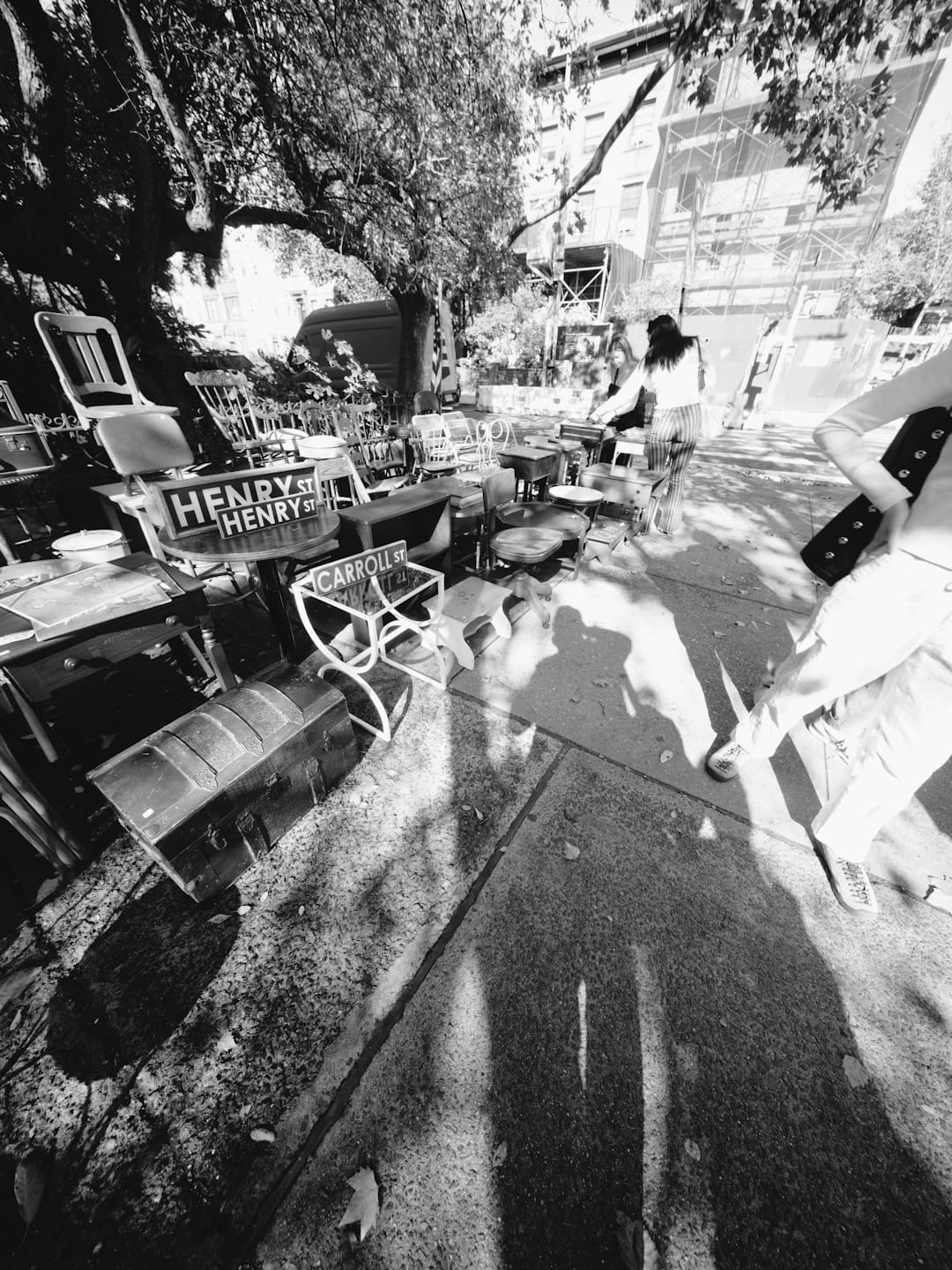
Fort Greene, Brooklyn, MMN Correspondent: The night the New York Knicks ended a 53 year championship drought, the city didn’t just celebrate. It exhaled. Fans poured into streets from Harlem to Times Square, but one man chose a quieter stage: a sidewalk in Fort Greene, Brooklyn, with a hand cranked machine named Jessica.
Ramell-Coreen Frederick, known to everyone as Cheeks, sat outside Habana Outpost as the final buzzer sounded. His setup was modest. A 3x2 foot table. A portable generator. And a 104 year old Singer embroidery machine that looked more like a museum piece than a tool for modern fandom. But what happened next turned ordinary jerseys and caps into something far more valuable: memory.
Cheeks didn’t sell new gear. He asked people to bring what they already owned. A faded Knicks jersey. A worn denim jacket. A cap that had seen better days. For a humble $20, he would stitch custom designs into each piece. Some wanted simple text: “2026 Champs.” Others got creative: “Send the Spurs to the Knick-U.” Every item became a one of a kind artifact of a city’s long awaited joy.
Why does this matter? Because in an age of mass produced merchandise, Cheeks offers something rare. He doesn’t just decorate fabric. He transforms it. Each stitch is manual. Each letter is plotted by hand on paper first, then carefully guided through the machine. The process can take anywhere from a minute for a small patch to 48 hours for a large scale piece like his tribute to Chadwick Boseman, a 24x36 inch embroidery that required two full days of focused work.
His machine, Jessica, is part of a trio of heirloom tools. There’s Bertha, a 124 year old French longarm model named for her size. And Story, an Indian made international machine he acquired just last year. None of them are digital. They require manual cranking, thread tension adjustments, and a patience that feels almost foreign in today’s fast paced world. Cheeks calls this analog precision. It’s a craft that demands presence.
His path to this moment began in a Brooklyn basement. Born and raised in Queens, Cheeks grew up surrounded by sewing culture. His grandmother was a professional seamstress. But for years, fear kept him away from the machine. Then he took a single sewing class at a local collective. His first seam was uneven. He showed it to his grandmother, who simply said, “Look at how your lines are uneven.” He tore it out, re stitched it perfectly, pressed it, and presented it again. Her response: “That’s how you put a seam together.” That lesson became his foundation.
Though he briefly interned with a patternmaker, Cheeks is largely self taught. He was expelled from an art high school, a setback that freed him to forge his own path. “I went rogue,” he says. That decision led to a career where creativity, community, and craft converge. His embroidery business operates through word of mouth, direct messages, and serendipitous encounters. “Or honestly, just finding me in the streets,” he adds with a smile.
Cheeks doesn’t limit himself to basketball. He sets up outside concerts, Pride events, and subway stations. Anywhere people gather, he finds his canvas. His first “going rogue” moment was at Brooklyn Bridge Park, where passersby stopped to watch, chat, and commission work. The energy, he notes, is contagious. “It’s not about the product,” he insists. “It’s about the moment, the interaction, the shared joy.”
On that championship night, Cheeks created 15 distinct Knicks themed items. Each one unique. Each one meaningful. He doesn’t keep them. He returns them to their owners after completion. But he carries the memories, the stories, and the raw energy of the night in his mind. That’s his real collection.
Looking ahead, Cheeks dreams of larger canvas works. Wall installations. Public art projects. Large scale embroidered narratives that challenge perceptions of embroidery as mere decoration. “I don’t do this with the intention of being in the fashion world,” he clarifies. “I do it as an artist.” His vision aligns with a growing global movement that values slow fashion, upcycling, and the democratization of art. In an era of mass production, Cheeks offers authenticity, intimacy, and individuality.
The Knicks’ 2026 win was more than a sports achievement. It was a cultural reset. And in that moment, a quiet man with a vintage machine reminded everyone that history isn’t only written in headlines or championship rings. Sometimes, it’s stitched into fabric, one deliberate thread at a time.
This story isn’t just about a Knicks fan or a talented tailor. It’s about the power of art to unite, heal, and celebrate. In a world increasingly defined by digital noise, Cheeks’s analog craft stands as a testament to human connection, patience, and purpose.
Related in Fashion

Fashion
Why Your Next Wardrobe Could Be Made of Mushrooms: Inside Ambush’s Spring 2027 Collection
What happens when a Tokyo fashion house decides to stop chasing global trends and instead listens to the forest? You get Ambush’s Spring 2027 Ready to Wear collection, unveiled during Paris Fashion Week. This is not just a new line of clothes. It is a quiet rebellion against the…
Read More...
Fashion
What Maria Grazia Chiuri’s Fendi Debut in Rome Means for the Future of Haute Couture
On a warm July evening in Rome, something quietly extraordinary happened inside the Galleria Nazionale d’Arte Moderne e Contemporanea. Maria Grazia Chiuri, fresh from a decade at Dior in Paris, returned to her hometown to present her first haute couture collection for Fendi. The…
Read More...
Fashion
What Happens When 18th Century Opulence Meets AI Couture? Jean Paul Gaultier’s Fall 2026 Collection Has the Answer
Imagine stepping into a dream where powdered wigs and corsets collide with laser scans and biomechanical forms. That’s exactly what happened when Jean Paul Gaultier unveiled its Fall 2026 haute couture collection during Paris Fashion Week. The show marked the debut of designer D…
Read More...
Fashion
20 Years of Masks: How Ashi Studio’s Fall 2026 Couture Turned Paris Fashion Week Into a Surrealist Dreamscape
What happens when a fashion house celebrates two decades not with a retrospective, but with a full-blown theatrical meditation on identity, disguise, and the art of concealment? Ashi Studio answered that question on the Fall 2026 runway, and the answer was nothing short of mesme…
Read More...
Fashion
How Magda Butrym’s 2027 Resort Collection Turns a Cult Film Into Wearable Art (And Why NYFW Is Next)
What happens when a designer takes a cult Polish psychological thriller and turns it into a wardrobe you can actually wear? Magda Butrym’s 2027 Resort collection offers a compelling answer. Titled ‘Szamanka,’ after Andrzej Żuławski’s 1996 film about power, desire, and identity,…
Read More...
Fashion
7 Ways Berlin Designer Mario Kleine Is Redefining Menswear with History and Emotion in Spring 2027
What happens when a designer stops chasing the next big thing and starts listening to the whispers of the past? Mario Kleine, the mind behind Berlin based label Marke, just answered that question with a collection that feels less like fashion and more like a conversation across…
Read More...
Fashion
7 Reasons Gigi Hadid’s Salmon Pink Wiederhoeft Dress and Soft Serve Hair Are the 2026 Wedding Trend You Need to Copy
Picture this: a candlelit seaside soirée, the air thick with romance, and every guest dressed like a character from a dream. That was the scene at Taylor Swift and Travis Kelce’s 2026 wedding, an event that didn’t just celebrate love—it launched a new era in fashion. Among the a…
Read More...
Fashion
Inside Taylor Swift and Travis Kelce’s Madison Square Garden Wedding: Music, Fashion, and Surprises You Need to Know
Imagine the world’s most famous pop star and an NFL superstar saying “I do” inside a legendary arena that has hosted everyone from Elvis to the Knicks. That’s exactly what happened on July 3, 2026, when Taylor Swift and Travis Kelce turned Madison Square Garden into their privat…
Read More...
Fashion
Why Fashion Insiders Are Calling Anna October’s Resort 2027 Collection a Love Letter to Paris (And You’ll Want Every Piece)
In July 2026, the fashion world’s gaze settled on Paris for reasons beyond its famed boulevards and iconic landmarks. Anna October presented her Resort 2027 collection, titled ‘Café Pleasure,’ at an intimate event that wove together architectural inspiration, historical nods, an…
Read More...
Fashion
7 Ways Mykonos Transformed Duckie Brown’s Spring 2027 Menswear Into a Mediterranean Dream
What happens when two Brooklyn designers trade the roar of subway trains for the whisper of Aegean waves? Daniel Silver and Steven Cox, the minds behind Duckie Brown, found out this spring. They spent months on Mykonos, not as tourists but as students of the island’s quiet rhyth…
Read More...