
Barcelona’s Walls Speak: 40% More Street Art Demands Justice for All. Here’s What It Says
We compile, generate and translate using Artificial Intelligence from the below given source. Macro Micro News is responsible for its editorial publication.
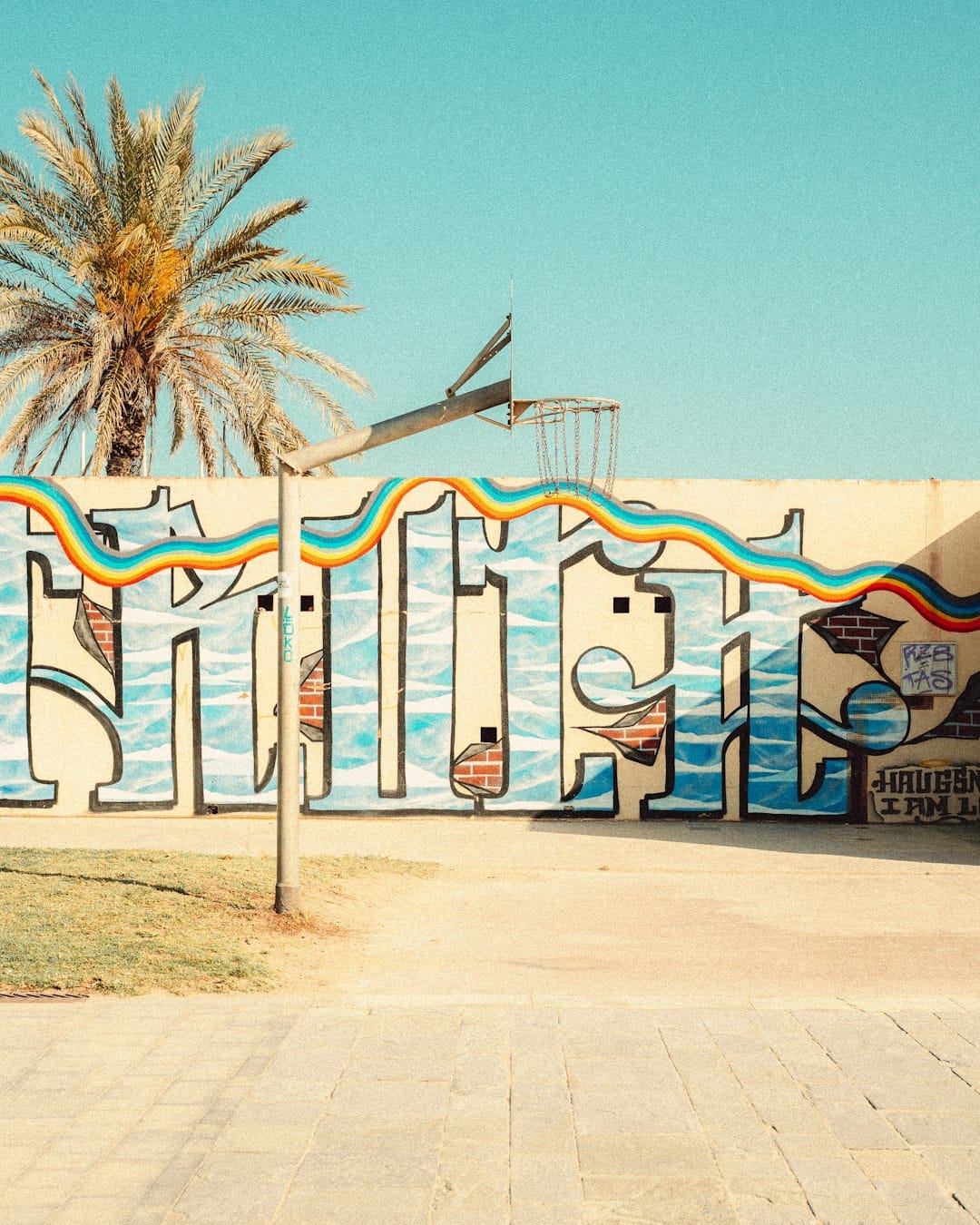
Barcelona, Spain, MMN Correspondent: In a city known for Gaudí and the Mediterranean, there is another language being written across walls. Iusticia Omnibus. Justice for all. The phrase shows up in huge murals, tiny stencils, and quick tags. It is easy to miss if you are not looking. Once you see it, you cannot stop seeing it.
What drives someone to paint justice on a wall in the middle of the night? Why does a neighborhood adopt a Latin phrase as its own? The answers are in the art itself.
Barcelona has always used its public spaces to tell stories. During the Franco years, murals spoke against fascism. Later, walls carried messages about climate change and gentrification. Now, as cities around the world search for ways to talk about inequality and recovery, the streets of Barcelona have become an open forum. No permission needed. No filter. Just paint, stencils, and a message.
The phrase 'Iusticia Omnibus' has older roots. It echoes Cicero and the ideals of the Enlightenment. In 2026, it carries a renewed sense of urgency. On these walls, it feels immediate. In neighborhoods where housing costs have climbed and tourism has reshaped daily life, justice is personal. The Gothic Quarter's narrow alleys are full of murals showing eviction notices, rent strikes, and community resistance. Each piece documents a struggle and asks a simple question. What kind of city do we want to live in?
One of the most striking pieces sits in Poblenou. The neighborhood used to be industrial. Now it is a tech hub. The mural shows hands of different skin tones, ages, and abilities reaching toward a glowing scale of justice. Above it, the words 'Iusticia Omnibus.' The artist collective La Fábrica de Sueños said the work came from the global protests for racial equality and climate action. They described justice as a collective project. Everyone, they said, has a role to play.
The same idea appears across the globe. In Minneapolis, murals followed the Black Lives Matter movement. In Mexico City, feminist street art makes bold statements in public squares. Barcelona's version is tied to a long history of civic action. The 15-M movement, which began in 2011, used street art to document its calls for fair politics. Many of those artists are still active today. Their focus has moved to housing, migration, and environmental justice.
City leaders have paid attention. In 2024, the city council started a program to commission murals in underserved neighborhoods. The goal is to support artists and improve public spaces. This has sparked a meaningful conversation. Maria Soler, a sociologist at the University of Barcelona, points out that art created by residents has a different energy than art commissioned by officials. 'Street art loses its subversive edge when it becomes part of the establishment,' she says. The question of who controls public space remains open.
At the same time, street art has gained a wider audience. Tourists wander through El Raval and Gràcia to photograph the works. Cafes and shops have embraced the murals. Some artists prefer temporary forms, like chalk drawings that disappear with the rain. Others share their work online. The conversation keeps moving.
Numbers show the change. The Barcelona Street Art Archive, a citizen-led project, has counted a 40% increase in political murals since 2020. The archive maps and catalogs street art, making it a useful tool for researchers and activists. Jordi Puig, its founder, sees the rise as a sign of a broader shift. People want to be part of the change. The streets are their canvas.
The themes are wide open. Gender equality, the climate crisis, refugee stories. One mural in the Born district reads: 'Justice is a conquest.' In every case, the art is a call to look closer.
The phrase 'Iusticia Omnibus' appears on the seal of the United States Supreme Court. It was woven into the language of the French Revolution. Street artists have turned it into something personal. For them, justice is both a legal principle and a moral call. It lives in everyday actions.
Every Saturday, people gather in Plaça de Catalunya with signs reading 'Iusticia Omnibus.' They ask for affordable housing, better public services, and an end to police violence. The protests are peaceful and persistent. One participant said they are there to claim what is rightfully theirs. 'Justice for all means no one is left behind.'
In 2025, the United Nations published a report on global inequality. It noted that the richest 1% owns more than half of the world's wealth. The report called for urgent action. Street artists responded by turning those numbers into images. A mural in São Paulo shows a giant hand crushing a tiny figure. In Cairo, a stencil places a tank on one side of a scale and a child on the other.
Some Barcelona murals include QR codes linking to articles, videos, and petitions. The art does not stop at the wall. It invites participation.
As evening falls, the walls come alive under streetlights. Bob Bingenheimer, a 77-year-old graphic designer, has documented this scene for years. He has watched neighborhoods change and walls get painted over. What stays, he says, is the spirit of the people. They find a way to speak their truth, even with a can of spray paint. Street art offers a vision of a shared future. It crosses borders and languages. In Barcelona, that vision is written on every wall, for all to see.
Related in Social Justice
Social Justice
Macao 2026: The Essential Guide to Mastering World Heritage Management
How do we protect our most precious cultural and natural landmarks when urban sprawl and climate change threaten their very existence? This pressing question drives a new initiative launching in the Asia-Pacific region. The World Heritage Centre has joined forces with WHITR-AP S…
Read More...
Social Justice
How You Can Support Cross-Border Diplomacy to Restore the Yellow Sea Tidal Flats for 50 Million Migratory Birds
Imagine standing along a coastline where the rhythm of the tides shapes an entire continent. The Yellow Sea tidal flats stretch across China, North Korea, and South Korea, creating a dynamic intertidal zone that welcomes millions of migratory waterbirds each year. These wetlands…
Read More...
Social Justice
Queer Travel Safety 2026: Destinations on the Rise, the United States Sliding, and What Inclusive Tourism Means for Your Next Journey
What makes a destination feel safe for you as an LGBTQ+ traveller in 2026? The answer just got more complex. New data from ITB Berlin, A3M Global Monitoring, and Diversity Tourism shows that queer travellers are making choices in a fresh way. Legal equality is still on the table…
Read More...
Social Justice
Pa'lante Siempre: Denise Oliver-Velez's 80-Year Blueprint for Intersectional Liberation Still Demands Your Action
What does it take to keep pushing for justice for nearly eight decades? Denise Oliver-Velez offered an answer with her life. If you have ever felt torn between causes, she is the example you need. Born in 1947 and still organizing until her passing in 2026, she became a bridge b…
Read More...
Social Justice
What Can Three Youth Activists Teach Us About Tackling Discrimination, Gun Violence, and Digital Privacy?
What does it take for a young person to turn a painful experience into a force for change? For the activists featured in Amnesty International's Digital Disruptors project, the answer begins with personal history and quickly grows into something much bigger. On International You…
Read More...
Social Justice
Zambia's 2026 Elections: The Stalled Human Rights Reforms You Need to Watch
Can a country reclaim the promise of democracy after a season of setbacks? As Zambia's 13 August 2026 general elections draw closer, that question is on the minds of many citizens and observers. The country is at a moment of real possibility. The path forward depends on choices…
Read More...
Social Justice
North Carolina Death Penalty Symposium 2026: 20 Years After the Last Execution, You Can Shape What Comes Next
Twenty years have passed since North Carolina carried out an execution. On August 22, 2026, the discussion about what comes next reaches a key moment. The NC Coalition for Alternatives to the Death Penalty (NCCADP) will host a symposium called "Beyond the Death Penalty" at the E…
Read More...
Social Justice
20 Years After North Carolina’s Last Execution: A Landmark Symposium Looks Beyond Capital Punishment
Twenty years have passed since North Carolina carried out an execution. In that time, death row has not disappeared. More than 130 people still live there, and new death sentences are still handed down. On August 22, 2026, the NC Coalition for Alternatives to the Death Penalty (…
Read More...
Social Justice
Venezuela Quits the ICC and Rome Statute: What It Means for You and the Future of Justice
The acting government of Venezuela has formally stepped away from the Rome Statute, the international treaty behind the International Criminal Court. Official withdrawal documents reached the UN Secretary-General on July 24, 2026, and appeared in the UN's public registry on Augu…
Read More...
Social Justice
FIFA’s Governance Crisis: 5 Systemic Reforms You Need to See Before the 2034 World Cup
Football is facing a moment of truth. FIFA is in the middle of a governance crisis, and human rights organizations are raising a pointed question: can a new face at the top truly change the game? Their answer is a firm no. The call is for systemic transformation, an overhaul of…
Read More...