
Your KO II Just Got a Major Upgrade: Lo-Fi Mode, USB Audio & 40-Second Samples – Here’s What’s New
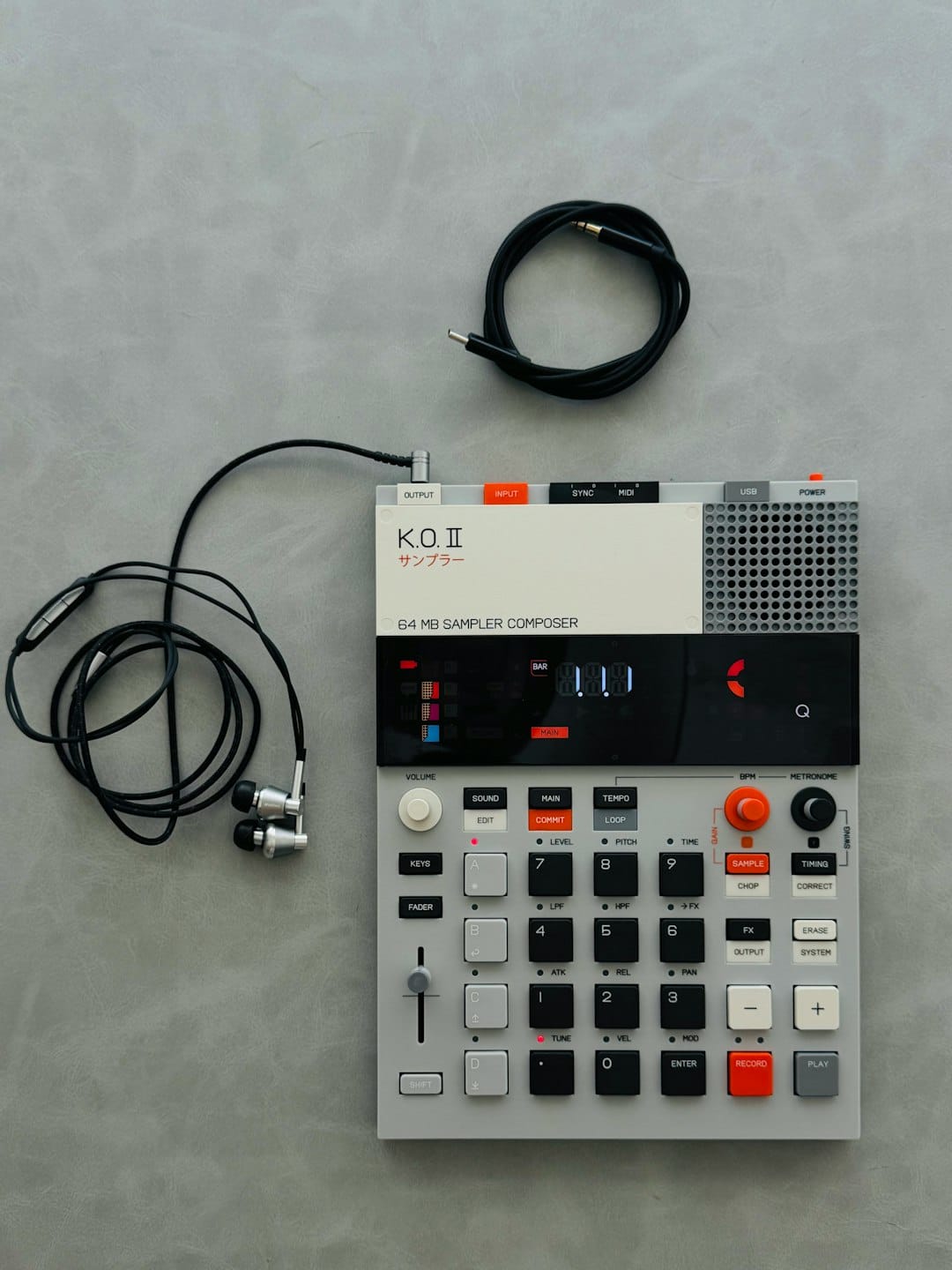
Stockholm, Sweden, MMN Correspondent: If you own a Teenage Engineering KO II sampler, you might want to sit down for this. The company just dropped OS 2.5, and it’s not your typical bug-fix update. We’re talking about a feature set that fundamentally changes what this $329 box can do. Think USB audio, a dedicated lo-fi mode, and double the sample time. But let’s start with the thing that’s going to make you smile.
You know that warm, crunchy sound you spend hours trying to dial in with plugins? The KO II now does it natively. The new selectable sample rates let you drop from the standard 46 kHz down to 32 kHz for a warmer tone, or all the way to 26 kHz for that gritty, early-video-game-meets-cassette-deck vibe. It’s not just a filter. It’s a whole new texture palette built into the hardware. And yes, it sounds as good as you’re imagining.
But the real headline here is USB audio. You can now plug the KO II directly into your computer or DAW and route audio both ways. No extra interface. No hassle. That means real-time monitoring, direct recording, and seamless MIDI communication all through a single cable. For live performers and mobile producers, this is the kind of feature that turns a sampler into a full production hub. It’s like the device just grew up without losing its playful soul.
Then there’s the sample reverse function. It sounds simple, right? But if you’ve ever tried to build tension with a reversed cymbal or create a glitchy transition, you know how essential this is. The KO II finally has it. And when you pair it with the new arpeggiator, things get really interesting. The arpeggiator works with any sampled sound, and given how good the KO II’s repitching engine is (fans compare it to the legendary Korg SK-1), you can turn a single vocal snippet into a full synthpop bassline or a dancefloor-ready rhythm. Adjustable speed, gate, and pattern length give you plenty of room to experiment.
Autochopping also got a serious upgrade. The old version relied on transient detection, which was great for drums but frustrating for melodic loops. Now you can chop by equal length, slicing any sample into uniform segments regardless of attack points. That means you can rearrange entire melodies or vocal phrases with surgical precision. And with the maximum sample duration doubled from 20 to 40 seconds, you’ve got more room to capture longer field recordings, vocal takes, or instrumental phrases. Loop-based producers, this one’s for you.
Time-stretching is smoother now too, with fewer artifacts when you push pitch or tempo. New scale options make harmonic input more intuitive, and per-pad time shifting lets you nudge each pad’s playback timing independently. That’s a subtle but powerful tool for creating off-kilter rhythms or tight, humanized grooves. The whole experience feels more polished, more responsive, and frankly, more fun.
And here’s the thing: this update isn’t just for the KO II. It’s also rolling out to the KO III, the reggae-themed sibling, so fans of that model get the same love. Meanwhile, the quirky KO IV continues to hold its niche among experimentalists. Teenage Engineering is clearly committed to keeping its hardware alive long after the initial purchase. That’s rare in this industry, and it builds a kind of trust that makes you want to invest in their ecosystem.
What does all this mean for you? If you’re into house, techno, hip-hop, ambient, or experimental electronica, the KO II just became a more complete production station. You can capture field recordings, manipulate vocal snippets, generate arpeggiated melodies, and export audio via USB all from a device that fits in a backpack. It’s a reminder that great tools don’t have to be complicated. They just have to evolve with you.
Related in Gadgets

Gadgets
How a Fake Cease-and-Desist Letter Targeted Flock Safety: What It Reveals About Trust in Surveillance Tech
In July 2026, a single image sent social media into a frenzy. A cease-and-desist letter, supposedly from Flock Safety, was circulating fast. It claimed the company had ordered a public lecture series in Newport Beach to stop discussing its surveillance technology. The post came…
Read More...
Gadgets
Microsoft’s Carbon Footprint Jumps 25%: What AI’s Energy Hunger Means for Your Digital Future
Microsoft just dropped a number that’s turning heads in the tech world: a 25% spike in carbon emissions for 2025. That’s 34 million metric tons of CO₂ equivalent, and it’s not a small blip. It’s a direct signal that the race to build smarter AI is colliding with the planet’s lim…
Read More...
Gadgets
7 Ways Meta's Always-On Smart Glasses Could Change How You Remember Everything
Imagine a pair of glasses that quietly listens to your conversations, notes the faces you meet, and remembers where you left your keys without you ever asking. Meta is reportedly building exactly that: a new generation of smart glasses designed to run in an always-on mode, captu…
Read More...
Gadgets
Meta Smart Glasses Update: Camera Disabled Instantly If Privacy Light Is Blocked or Removed
Imagine you are wearing a pair of smart glasses that can record video with a simple tap. Now imagine someone nearby covers the tiny light that tells you the camera is on. Until recently, that was possible. But Meta just changed the rules. The company has released a new software…
Read More...
Gadgets
Hoto PixelDrive Cordless Screwdriver Hits $60: The Smart Tool DIYers Have Been Waiting For
If you have ever struggled with a stubborn screw in a dark corner or stripped the head of a tiny fastener while assembling furniture, you know the frustration. The Hoto PixelDrive cordless screwdriver is now available for $59.99, down from its usual $80. This is the first time i…
Read More...
Gadgets
Inside the $75,000 AI Schools Where Your Child Becomes a Beta Tester for Tomorrow's Learning
Walk into an Alpha School classroom, and you won't see a teacher at the front of the room. Instead, you will find rows of students wearing lightweight headsets, their eyes fixed on adaptive screens that shift content in real time based on their facial expressions and response sp…
Read More...
Gadgets
Can a Space Tug Save NASA’s Swift Observatory Before It Burns Up? The 9-Month Rescue Mission You Need to Know About
Imagine a satellite that has spent more than two decades unraveling the universe’s most violent explosions. Now imagine it’s falling. That’s the reality NASA faced earlier this year when the Swift Observatory, a workhorse of astrophysics, began a slow but steady descent toward E…
Read More...
Gadgets
Amazon Fire HD 10 Just Got Faster: 4GB RAM Upgrade in 2026 – What It Means for You
If you have been eyeing a budget tablet that can keep up with your daily multitasking, Amazon just gave you a reason to pay closer attention. In a move that flew under the radar, the company quietly boosted the RAM on its popular Fire HD 10 from 3GB to 4GB. This change, confirme…
Read More...
Gadgets
From 600,000 Discs a Day to Microlenses: What Sony’s Austrian Factory Pivot Means for AR, Cars, and Your Future
Imagine a factory that once stamped out 600,000 PlayStation discs every single day. Now imagine that same facility, just a few years later, shaping tiny lenses that bend light for self-driving cars and augmented reality glasses. That’s exactly what’s happening in Thalgau, Austri…
Read More...
Gadgets
Apple’s 2027 MacBook Pro: Touchscreen, M7 Chip, and a Design Shift You’ll Want to See
Apple is quietly preparing to rewrite the rules for its entry-level MacBook Pro. If the latest reports from industry insiders hold true, the laptop you might buy in 2027 will look, feel, and behave nothing like the one on shelves today. The company is planning a complete overhau…
Read More...